Showing posts with label nature. Show all posts

Lizards - smarter than we thought

A vibrant green tree-dwelling lizard has surprised scientists with its mental prowess by succeeding in a problem-solving test.

The tropical lizard Anolis evermanni was able to associate the colour of a disc with a food reward - flipping over the correct disc to reveal a worm secreted underneath.

Read More - BBC Nature

Amazing Feather Paintings

Feathers can be colorful and spectacular in their own right, but how much more stunning might they be when used as canvases for artists, eager to demonstrate their talent for the unusual?

Alaskan-born and -bred artist Julie Thompson is an astounding exponent of this incredible art form. Julie, a self-taught wildlife artist for nearly 20 years, strives to make every feather painting as unique as the feathers themselves are, and believes that every feather has a kind of personality relating to the painting it bears.

Source
via Presurfer

What's new?

New species discovered in 2010

From invisible squids to bald parrots to deep-sea fish with teeth on their tongues, guardian.co.uk picks the best of of 2010's newly discovered animals.

This image provided by NOAA shows a deep-sea chimaera. Chimaeras are most closely related to sharks, although their evolutionary lineage branched off from sharks nearly 400m years ago, and they have remained an isolated group ever since.

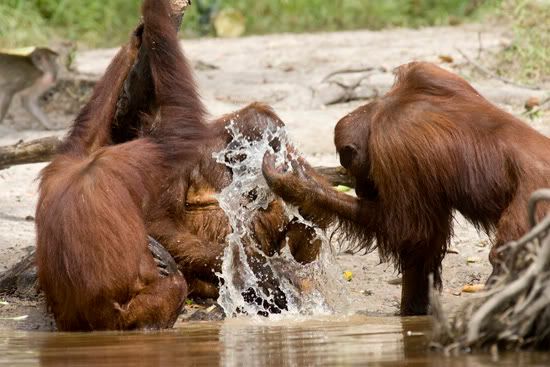
Meet me at the swimming hole

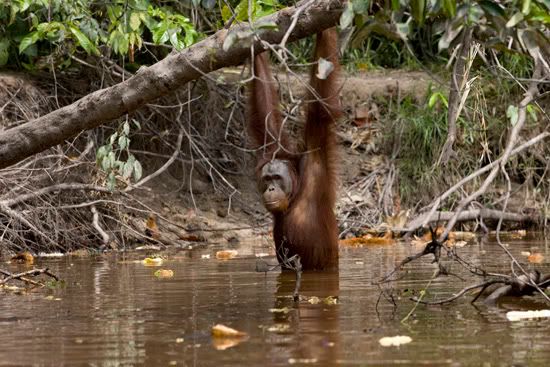
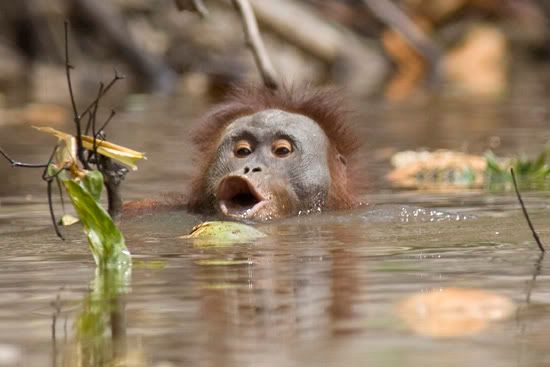
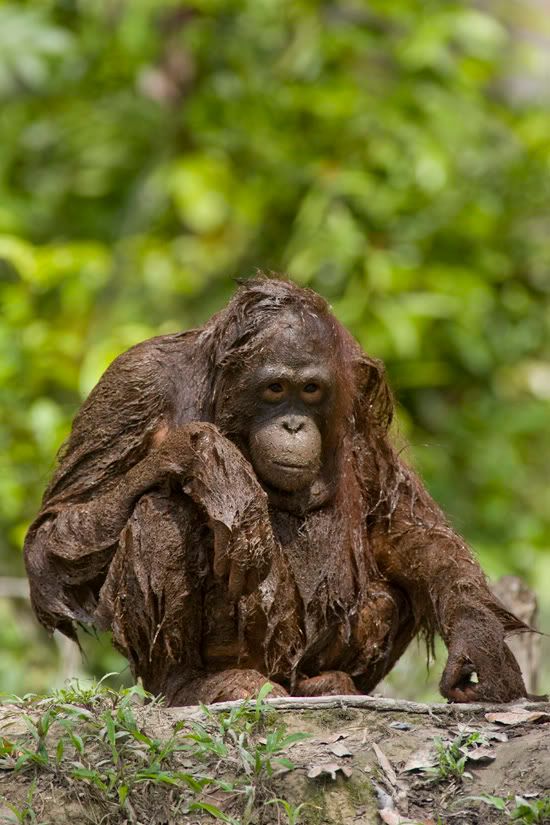
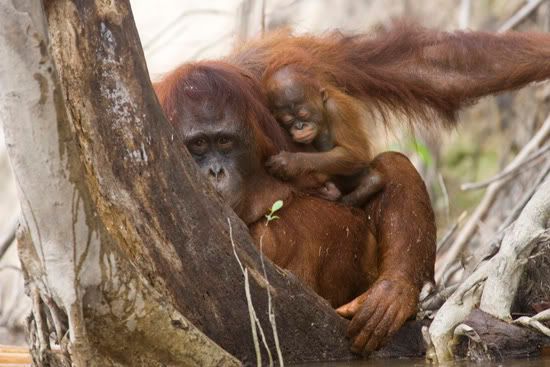
These incredible pictures of orangutans swimming in an Indonesian
river have left wildlife experts stunned.

Playing on the Rungan River, near to Palas Island on Borneo, these
orangutans can be seen swimming and submerging themselves in the muddy
waters.


For experts the behaviour of these orangutans – who like all apes have
a natural fear of water because of predators such as crocodiles -
could prove to be a significant step forward in their evolution.

“This is a rarity – to see orangutans coming down for a swim is
unheard of in the wild,” says Simon Husson – project advisor and
scientific consultant for Borneo Orangutan Survival (BOS) Foundation.

“However, we know that orangutans are intelligent and innovative."

Source

Gay German Zoo Pair Raising Baby

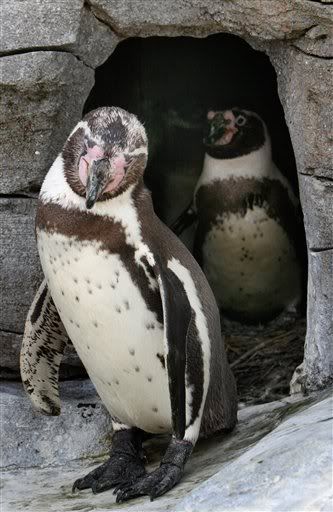
Two male Humboldt penguins cautiously guard the entrance to their cave in the "Zoo am Meer" zoological park in Bremerhaven, northern Germany, where they are fostering a six weeks old penguin chick.

After a penguin egg had been abandoned by its biological parents, it was placed in the male penguins' nest, who then adopted and hatched it.

Bremerhaven zoo veterinarian Schoene said the male birds, named Z and Vielpunkt, are one of three same-sex pairs among the zoo's 20 Humboldt penguins that have attempted to mate.

AP Photo/Focke Strangmann

Source

Wild Wonders of Europe

Wild Wonders of Europe showcases beautiful photo galleries sponsored by National Geographic which highlight the flora and fauna of Europe.

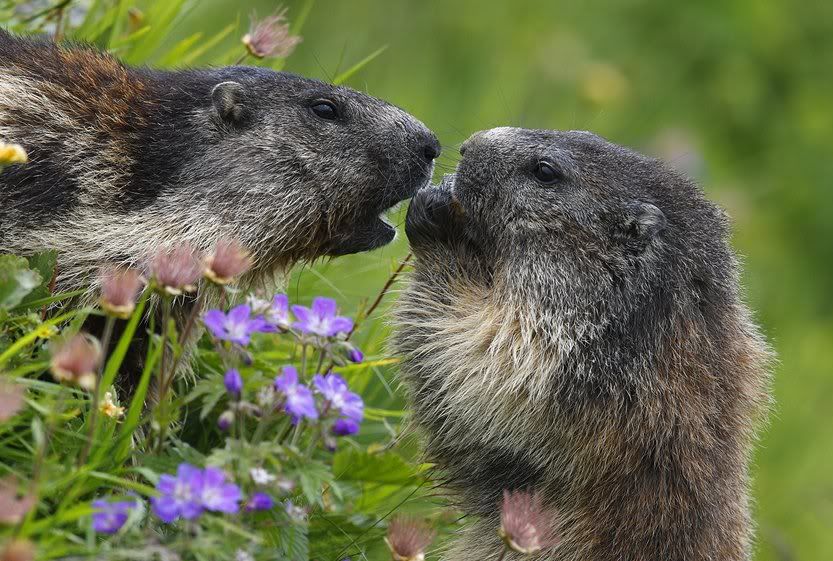
This is Marmots Feeding on Flowers by Grezgorz Lesniewski, from the Austria Galleries

International Garden Photographer of the Year

The finalists of the UK's International Garden Photographer of the Year award have just been announced.

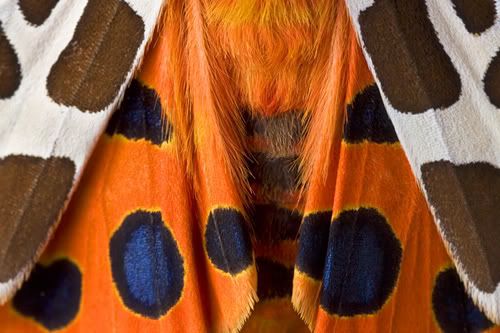
Garden tiger moth close-up by Paul Keene

This picture of a garden tiger moth (Arctia caja) was taken in Amersham, Buckinghamshire. The caterpillars of this moth feed on nettles, so if you want these moths to be a feature in your garden, then keep a rough, uncultivated patch

(via Look at This)

The Most Dangerous Bird on Earth

The rainforest of the northeastern coast of Australia is home to the Southern Cassowary and as the third largest bird on the planet it is strange that its reputation is not greater. Certainly, it is a remarkable looking animal, almost like something out of ‘Jurassic Park' with its large casque (a horn like crest which indicates age and dominance) positioned, dinosaur-like on its forehead. Estimates vary but it is thought that only around 1500 of this mysterious and ancient creature still survive in the wild.

Considered dangerous because when the birds become frightened (they are naturally skittish) they can attack and do damage with their claws, one of which is almost five inches in length. Their inner toe in the medial position looks like a dagger. When panicked these birds have been known to kick - and sometimes kill - dogs and humans.

Urban myths abound about the birds being able to disembowel a man with their claws. The last record human death by cassowary was in 1926. The claws however cannot do this - though they can leave a nasty puncture wound up to two centimeters in diameter.

Source

(via Webphemera)

Getting squirrelly in DC

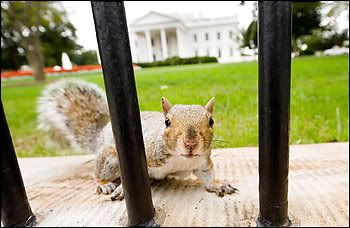
Some Washingtonians love them. Some hate them. But perhaps the prevailing sentiment toward the city's squirrels is indifference. After all, seeing a gray squirrel rushing around downtown as if he has important places to be is about as unusual as seeing a guy in a charcoal suit doing the same.

But it wasn't always that way.

A little more than a century ago, the District's downtown parks and green spaces didn't have a squirrel population to speak of. Eastern gray squirrels are native to this area, but they had been largely wiped out in the most urban parts of town by the late 19th century because of hunting, which wasn't outlawed in much of the city until 1906.

Looking to fill the squirrel vacuum, nature lovers, government officials and other civic-minded residents in the early 1900s pushed to have areas including Lafayette Square, the U.S. Capitol grounds and the Mall stocked with squirrels.

The organized release of gray squirrels into Washington's parks and green spaces is a little-known chapter in the story of the city's development. Even park historians and scientists who have studied the District's squirrel populations weren't aware of these squirrel-stocking endeavors.

Source: Washington Post

(via corsinet)

14-year-old Helps Solve Avian Mystery

At 14 years old, Spencer Hardy has solved an avian mystery and discovered significant evidence for the only bird other than a penguin to incubate its eggs on glacial ice.

Hardy's geoscientist father, Douglas, was stationed in southeastern Peru at the Quelccaya Ice Cap in the Andes for long-term research on climate change. He was studying glacier melting rates when his son, in sixth-grader at home in Vermont at the time, identified White-winged Diuca Finches (Diuca speculifera) from his father's photographs taken from the site. Spencer started to realize that these birds could be responsible for mysterious nesting sites his father had found scattered along the edge of a glacier.

Like penguins, these small birds endure brutal nesting conditions for weeks on end — low oxygen, bitter cold, heavy snow and high winds. Despite these circumstances, they still nest exclusively on the glacier, the father and son report in the September 2008 issue of the Wilson Journal of Ornithology.

Source: US News

The world's most endangered species 2008

The red list includes 188 mammals in the highest threat category of critically endangered, including the Iberian lynx (Lynx pardinus), which has a population of just 84-143 adults and has continued to decline due to a shortage of its primary prey, the European rabbit (Oryctolagus cuniculus.)

Nearly a quarter of the world's land mammal species are at risk of extinction, and many others may vanish before they are even known to science, according to a major annual survey of global wildlife

Source: Guardian

The hungry frog

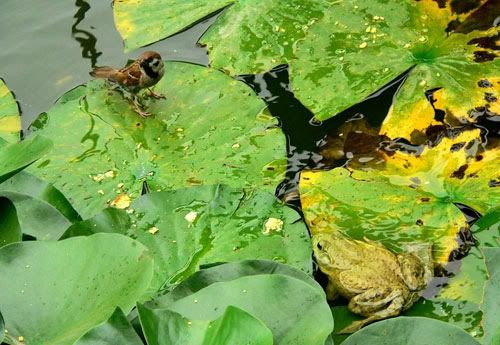
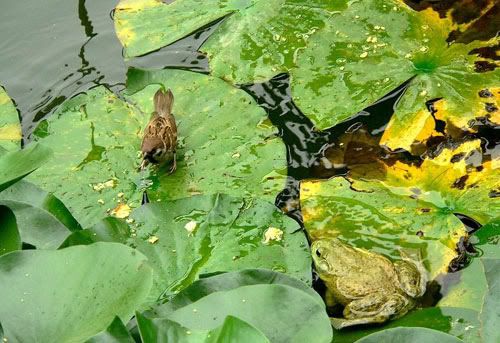
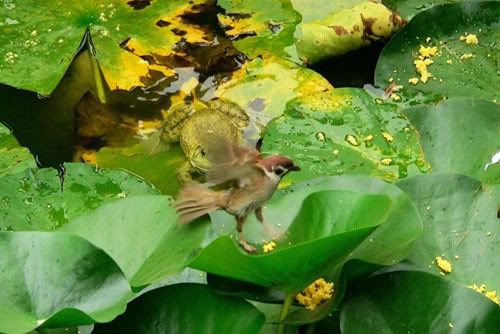
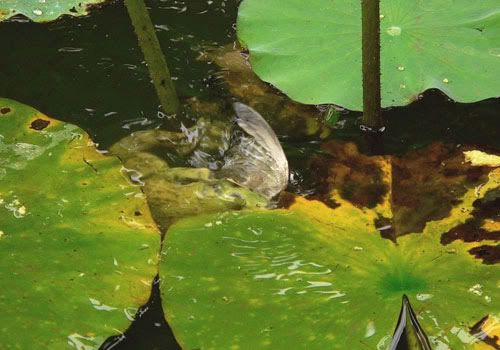
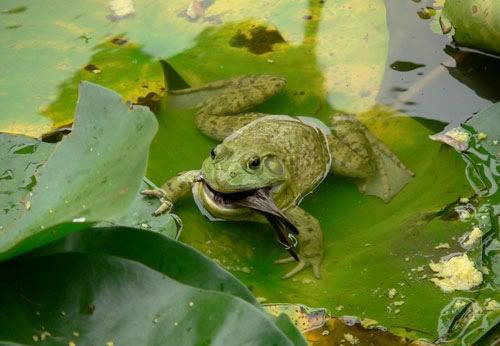
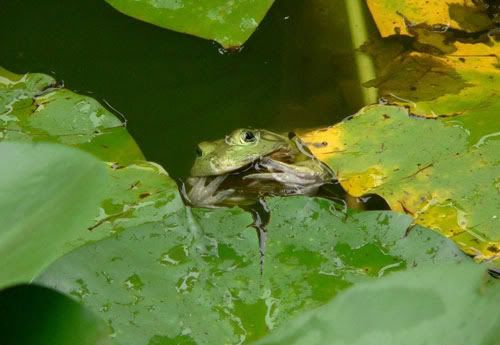
We have a little koi pond in our back yard. One of our favorite amusements is our "froggie." We have watched him grow for the past several years. We were greatly surprised one day to visit the pond and find Froggie with a half swallowed sparrow protruding from his mouth. He caught a little more than he could eat.

The following are NOT my photos - but they tell the story very well ...


(photos via Cellar)

Photography by Staffan Windstrand

Since 1998 Staffan Windstrand has been very active in a five-year media project (together with friends and colleagues Magnus Elander and Johan Lewenhaupt), called ”The Scandinavian Big Five”, in which they try to cover all aspects of the five large Scaninavian carnivores – the wolf, the bear, the lynx, the wolverine – and man.
Man being the by far most common, most distributed, most dangerous and most ruthless of them…

There are many more wonderful nature photos at the Staffan Windstrand Gallery.

Here's my hummingbird ...

We've had a wonderful patch of bee balm planted in our backyard that has had hummingbird visitors for many years. As much as I try, I have yet to get a good photo - they are so QUICK!

Here's my latest (poor) attempts:


(You can click on the photos, go to Flickr, and see them larger)

These little birds are a delight. Even though we see several every day, it's still an occasion to stop what I'm doing and marvel at nature.

Hummingbird stories:
One day, I was sprinkling the flowers and a hummingbird repeatedly flew into and out of the water drops. She was taking a shower!

Hummingbirds are very territorial. When more than one arrive at the same flower bed at the same time, there's a very loud shrieking dispute until one backs off and leaves. We have seen the looser sit on a branch to wait her turn.

Just last week, we watched a hummingbird fly into a swarm of small gnats. She darted quickly from bug to bug, eating them. We've never seen that before! I thought all hummingbirds did was suck the nectar from flowers. This little bird caught so many bugs, she had to sit on the fence netting around the vegetables and rest. She sat there a good five minutes before she could fly. Talk about over eating!

Late summer brings hummingbirds to Illinois

August and September provide some of the year's best opportunities for observing hummingbirds in Illinois, according to Rob Kanter, author of The University of Illinois' Environmental Almanac. That's because individuals that have been farther north during the breeding season gather here on their way south.

Despite their small size, many hummingbirds migrate over long distances. Ruby-throats heading south may travel 2000 miles to reach their winter territory in southern Mexico and Central America, including a 500-mile nonstop leg of the trip over the Gulf of Mexico.

While the ruby-throated is the most common, rarer hummingbirds -- such as the broad-billed, Rufous and Allen's -- are seen across the Midwest from late summer into fall. The Rufous hummingbird is occasionally seen at feeders.

Source: abc7chicago.com

A mother's grief -

Eleven-year-old gorilla Gana was holding her three-month-old baby Claudio in her arms on Saturday in her compound at the zoo in Munster, northern Germany, when it suddenly died.

Initially puzzled, Gana stared at the body, bewildered by its lifelessness.

For hours the distraught mother gently shook and stroked the child, vainly seeking to restore movement to his lolling head and limp arms. Visitors to the zoo openly wept as they witnessed her actions.

Hours passed, during which Gana continually prodded and caressed the dead child, to no effect.

But still she refused to give up hope. Gently placing it on her back and slowly walking around the compound, she stopped every few paces to look back and see if her much-loved son had returned to life.

'Claudio died in his mother's arms - we think from some heart defect,' said zoo director Joerg Adler.

'On Wednesday he didn't seem well. On Friday he wasn't eating or drinking and was growing weaker. We were keeping a close eye on him but suddenly, on Saturday morning, he died.'


Still think animals don't have feelings?

Source: MailOnline


But hold on ---

This is not Gana's first experience with motherhood.

Last year, she gave birth to her first baby, a female named Mary Zwo. Gana rejected Mary Zwo for six weeks. Staff at the zoo finally intervened and rescued the baby, which was taken to a veterinary hospital with dehydration and exposure. Mary Zwo was never returned to her mother and has lived at a zoo in Stuttgart with four other gorillas ever since.

This time, Münster Zoo rejected the idea of stepping in to save Claudio. "There was no point in intervening again," said Mr Adler. "We cannot keep on taking away children from a mother."

The world's biggest moth?

My friend Jake caught this monster moth in Crestwood, Illinois, in August, 2008. His daughter, age 8, is holding it. This has got to be the most ginourmous insect we've ever seen!

Does anyone know what this is?

Here's another look ...

Yes, yes, we let it go after pictures were taken.

Photos: Julie Corsi

A 400-year long wait

Captured on camera as they swim in a lake, drag pieces of wood to make their dens and play with one another, these are the first beavers to be born in Britain in 400 years.

The enchanting scene is a heartwarming sight for animal lovers as the species was previously extinct in Britain.

The 12 baby beaver ‘kits’ – all from the same mother – were born at the 550-acre Lower Mill Estate near Cirencester, Gloucestershire.

Jeremy Paxton, owner of the estate, brought three pairs of beavers – named Tony and Cherie, Gordon and Sarah and John and Pauline – from Bavaria in 2005.

He has spent almost £1million on the project.

He said: ‘I have always wanted to bring an extinct indigenous species back to Britain.

Source: The Daily Mail

Video: Borneo Apes - Malaysia

By some estimates, Borneo's vast forests are being cleared faster than the Amazon. Unless something is done now, Orangutans could be extinct in 20 years.

The practice of bulldozing everything to make way for palm oil plantations has left Orang-utans without their customary habitat.

Lone Droescher-Nieslen from the Orangutan Survival Foundation hopes she can rehabilitate the Orangutans back into the wild. But if the rate of deforestation continues, there may soon be no forests to release them into...

Watch the video