A close second?

The Daily Mail has printed photos of Orazi, the ginger tom cat who weighs in at a whopping 35.2 lb. Orazi lives in Eupilio, Italy.


I think Monty, who lives with my friends Christina and Luke, is almost as large as Orazi. I'm not sure how much Monte weighs - they probably can't lift him up to weigh him.

What do you think? Close?

Cindy: the queen of doggy tricks

Meet Cindy, the Cavalier King Charles who’s the queen of doggy-balancing.


Cindy the Cavalier King Charles is able to carry out a dazzling display of tricks taught to her by Wolverhampton owner Ron Bucknall.

Watch the video of Cindy performing. via: Ursi's Blog

Source: expressandstar.com

Custom wheelchairs keep disabled pets moving


This picture says it all. A recent article discussed how wheelchairs are being built to help disabled dogs.
According to the article, the motives are quites simple. "A growing number of pet owners are turning to custom-built wheelchairs to restore mobility to furry friends whose legs, hips or backs don’t work. The owners’ goals are simple: to reward their pets’ unconditional love with whatever it takes for the animals to live normally."
To read the entire article, http://www.msnbc.msn.com/id/23792467/

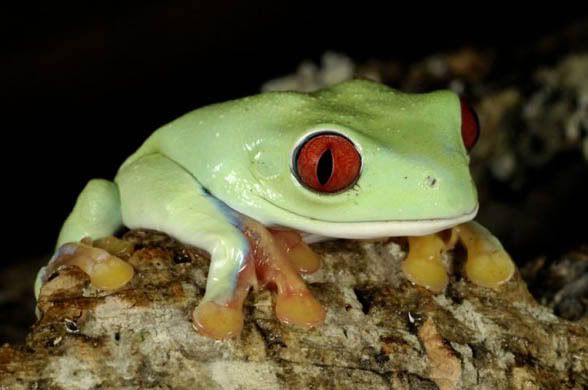
Cute or not? Red-eyed tree frog

African Wild Dogs Debut at the LA Zoo

African wild dogs, native to the vast and beautiful sub-Saharan Africa, are making the Los Angeles Zoo their home for the first time in nearly 40 years.


The African wild dog is an endangered species. It is estimated that the total population is fewer than 5,000 dogs.

L.A. Zoo's pair of dogs, courtesy of New York’s Bronx Zoo, is two of just under 150 African wild dogs in zoos across the United States.

These dogs are part of an aggressive plan to try and preserve the species. A number of zoos, including the L.A. Zoo, are looking to help wild dog conservation efforts by participating in the Species Survival Plan Program (SSP) established in 1981 by the Association of Zoos and Aquariums (AZA). The program tracks a species’ genetic ancestry so that appropriate mates can be found for the animal in question. For example, the L.A. Zoo has two wild dogs, but since they are brother and sister, it would be inappropriate to breed them. In the future, if the Zoo were to receive a breeding recommendation, the Zoo would work with the AZA to locate suitable mates for the dogs. A zoo that has a compatible mate would then exchange that animal with the L.A. Zoo so that the quality breeding programs could continue.