Showing posts with label amphibians. Show all posts

Weird news: Thousands Of Toads Invade CA Neighborhood

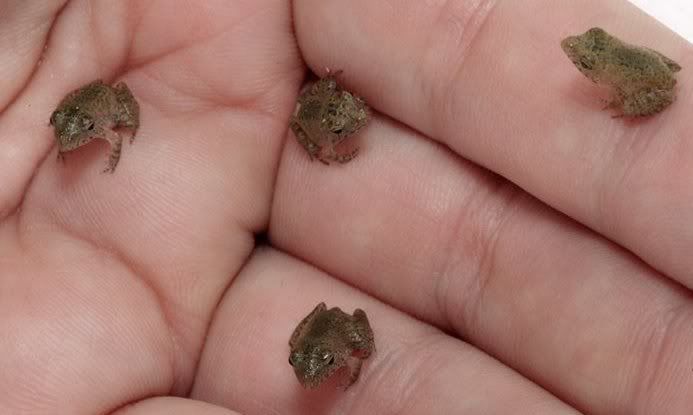
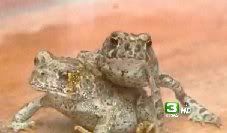
Tens of thousands of tiny toads have been hopping across streets, lawns and patios in a neighborhood of Marysville, Calif., this spring, and scientists say it's partly because of the California drought.

It started about three weeks ago in the neighborhood, which is in close proximity to a small drainage basin that collects rain runoff during the winter and spring. Neighbors told reporters with TV station KCRA that it's the first time they can remember the basin being bone dry.

Dale Whitmore, a California Department of Fish and Game biologist, said the drought killed all of the fish in the lake. Without any fish to eat the toads' eggs, the population exploded.

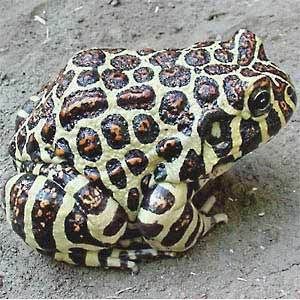
The western toads are now about the size of a quarter and range in color from gray to brown to green. By the end of the summer, they will be about the size of a human fist.

Source

Frog populations not helped by dinner menus

About one-third of all amphibians are listed as threatened species, with habitat loss the biggest factor.

But hunting is acknowledged as another important driver for some species, along with climate change, pollution and disease - notably the fungal condition chytridiomycosis which has brought rapid extinctions to some amphibians.

"Frogs legs are on the menu at school cafeterias in Europe, market stalls and dinner tables across Asia to high end restaurants throughout the world," said Corey Bradshaw from Adelaide University in Australia.

"Amphibians are already the most threatened animal group yet assessed because of disease, habitat loss and climate change - man's massive appetite for their legs is not helping."

Frogs are liquidised to make a "health drink" in parts of South America.

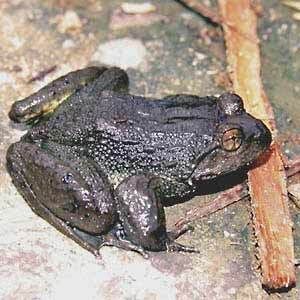
Frogs of the stream-dwelling Paa genus are among the most popular for hunting in China. But numbers in some areas have fallen 10-fold as a result of over-exploitation.

These frogs could be candidates for sustainable harvesting plans, where hunting is allowed but controlled. Image: Kadoorie Farm & Botanic Garden – KFBG

Rana chensinensis is declining steeply in some areas; a study in Heilongjiang found that the annual catch fell by 99% between 1971 and 1986. The main reason is traditional medicine.

Oil made from the female frog's oviduct is believed to be a tonic to the kidneys and lungs, and to cure respiratory ailments. Image: KFBG

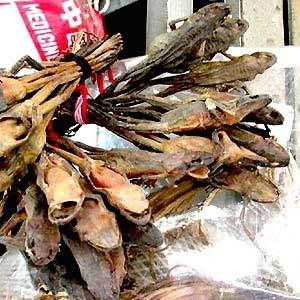
Frogs and toads are also sold as tonics in the markets of Peru.

This stallholder in Cuzco sells "Extracto de Rana", a drink made from the extract of two to three frogs, which is blended with honey, malt and other ingredients.

Other recipes call for 30 frogs in a single drink. Image: Esteban Lavilla

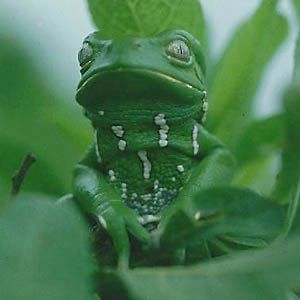
In western Brazil and eastern Peru, frogs of the Phyllomedusa genus are used as a hallucinogen.

Chemicals secreted by the frog's skin and introduced into a human's bloodstream are said to lead initially to vomiting and incontinence, then deep sleep, and finally a period of enhanced sensitivity in sight and hearing. Image: E. Lavilla

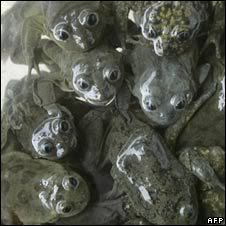
Leptodactylus laticeps is exported from South America to the developed world. It can fetch prices of 600 euros in European pet shops.

In some areas where it lives, in Argentina, Bolivia and Paraguay, people earn as little as 1,200 euros in a single year, giving them a real incentive to catch and sell it. Image: E. Lavilla

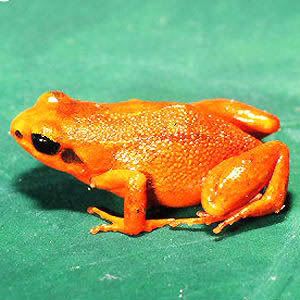
Mantellas are among the most popular frogs as pets. The principal source is Madagascar, from where many amphibians are exported into the pet trade.

This species, the black-eared mantella (Mantella milotympanum), is critically endangered. Habitat loss is also a major threat. Image: Franco Andreone/ARKive

Source: BBC
Cute or not? Crested gecko

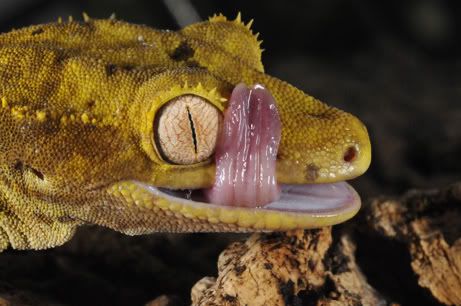
Lacking eyelids and true eyelashes, a New Caledonian crested gecko licks its eyeballs to keep them moist.

—Photograph by Julie Larsen Maher/WCS

Short-lived Chameleon

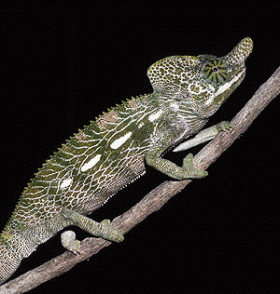
Scientists have discovered a chameleon species that spends a good two-thirds of its life inside an egg: Furcifer labordi lives about 8-9 months as an embryo, and has a post-hatching lifespan of just 4-5 months. As far as the scientists know, this strange life history is unique among all land vertebrates, and may help researchers better understand how certain ecological and hormonal factors influence life history evolution.

The small F. labordi lives in the extremely arid southwest region of Madagascar. The desert-like, spiny-forest area experiences a long dry season from March through November, and a rainy season between December and February. This harsh, variable environment may be one of the reasons for the odd life history of F. labordi.

Source: PhysOrg.com

(via A Welsh View)

Rare white albino tadpoles

Rare albino tadpoles have been found in a garden pond in Wales.

The tadpoles have the distinctive pink eyes and off-white skin coloration associated with albinism. Although isolated single examples of albino frogs, toads and newts have been seen before this is the first time a whole group has been found.

The pond's owner, who first noticed the white-tinged tadpoles, said he did not see any albino frogs using the pond during the breeding season.

Source: Telegraph

Deaths of Rare Crocodile in India Stir Alarm

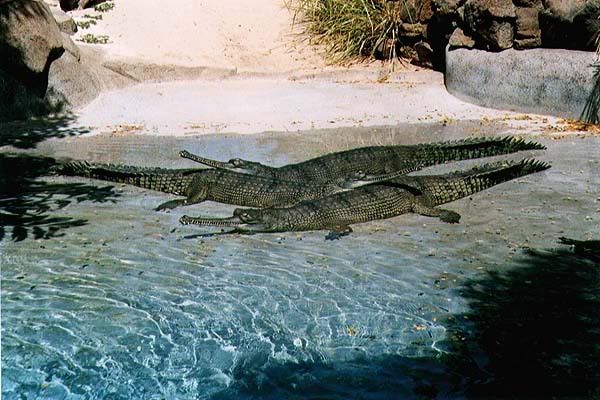
Three decades after it was brought back from the brink of extinction, the rare Indian crocodile known as the gharial is turning up dead by the dozens on the banks of a river called the Chambal. Forest officials are at a loss to explain why.

Since mid-December, the National Chambal Wildlife Sanctuary has confirmed 76 deaths along the river, which begins in the central Indian state of Madhya Pradesh and runs through Rajasthan and Uttar Pradesh.

Other species that inhabit the Chambal River ecosystem, including dozens of fish species on which the gharials feed, appear to be healthy.

Sourge: NY Times

Photo: Tim Dwight(Wildldife Web)

Weirdest and most endangered creatures

Amphibians as a rule are not cute and cuddly which puts them way down the pecking order of species that need to be saved.

But they are a key indicator species and if they start to decline it is a clear warning that the environment is in trouble.

The Zoological Society of London (ZSL) has drawn up a list of some of the world's most extraordinary creatures threatened with extinction.

They found 85 per cent of the top 100 of the 'world's weirdest and most endangered creatures' are receiving little conservation attention and will disappear if no action is taken.

ZSL has identified and is starting work to protect 10 of the most unusual and threatened EDGE amphibian species this year. They include:

*Chinese giant salamander (salamander that can grow up to 1.8m in length and evolved independently from all other amphibians over 100m years before Tyrannosaurus rex)

*Sagalla caecilian (limbless amphibian with sensory tentacles on the sides of its head)

*Purple frog (purple-pigmented frog that was only discovered in 2003 because it spends most of the year buried up to 4m underground)

*Ghost frogs of South Africa (one species is found only in the traditional human burial grounds of Skeleton Gorge in Table Mountain, South Africa)

*Olm (blind salamander with transparent skin that lives underground, hunts for its prey by smell and electrosensitivity and can survive without food for 10 years)

*Lungless salamanders of Mexico (highly endangered salamanders that do not have lungs but instead breathe through their skin and mouth lining)

*Malagasy rainbow frog (highly-decorated frog that inflates itself when under threat and can climb vertical rock surfaces)

*Chile Darwin's frog (a frog where fathers protect the young in their mouths, this species has not been officially seen since around 1980 and may now be extinct)

*Betic midwife toad (toads that evolved from all others over 150m years ago - the males carry the fertilised eggs wrapped around their hind legs)

*Gardiner's Seychelles frog (perhaps the world's smallest frog, with adults growing up to just 11mm in length - the size of a drawing pin)

Source: Telegraph

Cute and new: teeny little salamanders

Discovered in remote Costa Rican cloud forests, this amphibian's eye-catching coloration resembles the warning markings of deadly poison-dart frogs, also native to Central America.

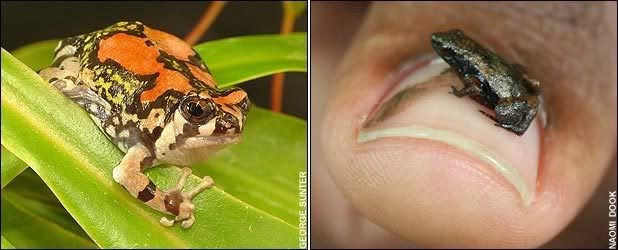
Small enough to fit on a fingernail, this amphibian is among several previously unknown salamanders recently discovered in Costa Rica, scientists announced on January 4, 2008.

Measuring 2.4 inches (6 centimeters) long, this newfound nocturnal salamander hunts insects at a snail's pace but with a “ballistic tongue."

Source: National Geographic

World's oldest tortoise dies

Addwaita, believed to be the world's oldest surviving tortoise, aged about 250 years, died in the zoo of liver failure.

Addwaita, which means "the one and only'' in the local Bengali language, was one of four Aldabra tortoises brought to India by British sailors in the 18th century.

Long after the other three tortoises died, Addwaita continued to thrive, living in Clive's garden before being moved to the Calcutta zoo in 1875.

Credit: AP Photo/Bikas Das

Froglets - they're like chicklets, but green

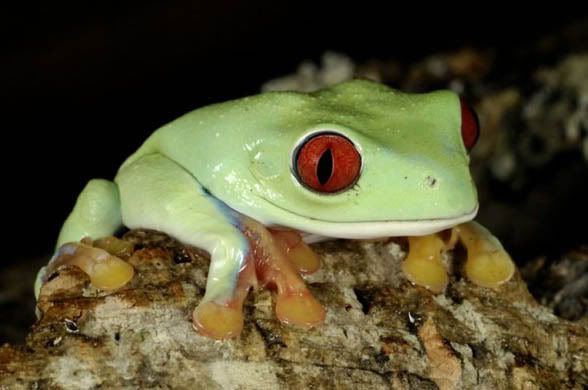
Solomon Island leaf frogs emerge from their eggs as fully-formed frogs, known as froglets.


Photo: Jessie Cohen / AP

Man-sized sea scorpion claw found

A 390 million-year-old fossilized claw of a sea scorpion has been reportedly found in a German quarry. The size of the creature’s claw estimates that it would have been at least 8 feet long. The size of the beast suggests that spiders, insects, crabs and similar creatures were much larger in the past than previously thought.

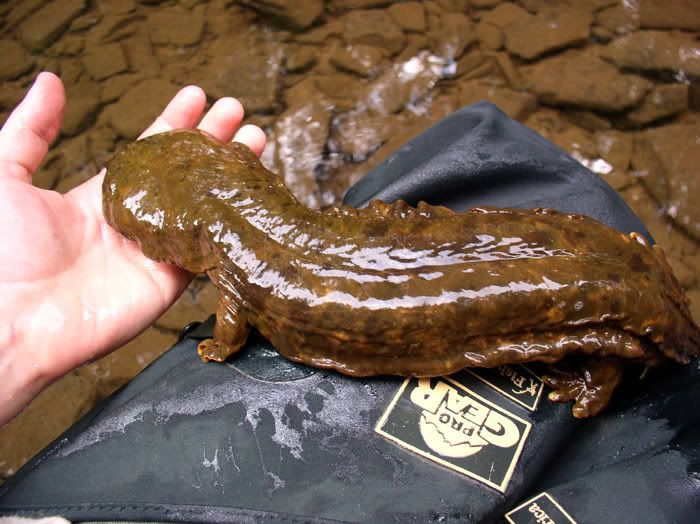
The hellbender


Which salamanders have four legs, a flat head, a paddle-like tail, beady little eyes and are called names like "snot otter" and "devil dog"?

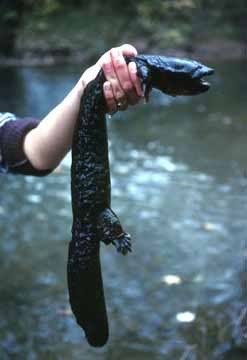
Also known as Allegheny alligator, mollyhugger, and mud cat, the hellbender (Cryptobranchus alleganiensis) is North America’s largest salamander, reaching lengths of nearly 30 inches.

These strange, but interesting creatures once thrived in thousands of pristine streams throughout the eastern United States. Populations have drastically declined, mainly because of declining stream quality. Not only has the hellbender population dwindled by 80 per cent in the last 30 years, but those remaining have severe deformities – missing toes, limbs and open sores. There is a 95 per cent chance of extinction of this animal over the next 75 years.

The average age of Cryptobranchus in the wild is unknown, but in captivity, they have lived as long as twenty-nine years.

Hellbenders are not venomous, though their skin secretions are somewhat toxic. They will bite, but only if they are really provoked. A common myth is that hellbenders will 'ruin' good fishing streams by eating all the fish. This couldn't be farther from the truth! In fact, if you see hellbenders in a stream, this is an excellent indication that the water quality is still good -- and this is good for both hellbenders and game fish. The hellbender's voracious appetite for crayfish also means that they are very important for keeping a stream's food chain balanced, and this is good for fish and the entire ecosystem.


Photo #1: Kurt Buhlmann
Photo #2: Jeff Humphries

Understanding Endangered Frog's Diet And Environment May Save It

A brightly colored tropical frog under threat of extinction is the focus of a new research project hoping to better understand how environment and diet influence its development and behavior.

Biologists from The University of Manchester have teamed up with experts at Chester Zoo in the hope that their findings will not only help save the splendid leaf frog Cruziohyla calcarifer from extinction in the wild but provide clues as to how it can be better catered for in zoos and aquariums.

Rare Blue Lobster Caught Off Mass. Coast

A blue lobster, so rare that only one in two million have the color, has been trapped off the Massachusetts coast.

The lobster, nicknamed Betty Blue, was found in a trap off Minot's Light, one mile offshore of Scituate, Mass.

The lobster is so blue that "she glowed in the trap," said Eddie Figueiredo, who trapped the pound-and-a-quarter lobster.

Rare leatherback sea turtles hatch in Walton, FL

Walton County’s fi rst-ever documented leatherback sea turtle nest has hatched, and 23 babies have made their way safely to the Gulf of Mexico.

After 79 days of close watch by the South Walton Turtle Watch Group, Walton County’s sea turtle nest No. 12, located in Seagrove just west of Seagrove Villas, came to life Oct. 6 following the day’s heavy rain.

At 9:15 p.m., Turtle Watch Volunteer Joe Burton checked on the nest and found a tiny flipper coming out of the sand. After making several phone calls, Burton, fellow volunteer Sharon Maxwell, and 23 other spectators crowded around the nest as the baby sea turtles slowly emerged and crawled into the water.

“A truly awesome sight,” Maxwell said.

Turtle Tipping Tricks Revealed

With a flat shell, the Argentine snake-necked turtle (Hydromedusa tectifera) often rights itself by pressing its head against the ground with its muscular neck, levering itself onto its belly. Credit: Gaabor Domokos.

For turtles, lying belly-up is a helpless, life-threatening situation.

Now it appears many turtles evolved shells with unique shapes to easily help them flip back onto their bellies if they find themselves on their backs.

"Before starting this project, I always thought animals such as turtles worked hard to right themselves, and what this showed was this need not be the case—they can just have a good shape for their shell that does most of the work," applied mathematician Peter Varkonyi at the Budapest University of Technology and Economics in Hungary told LiveScience.

Two-headed turtle goes on display

A two-headed turtle captured by a turtle collector is a rare example of a conjoined-twin birth, its owner said.

The turtle would have likely died in the wild because it swims awkwardly and would be an easy target for predators, according to Jay Jacoby, manager of Big Al's Aquarium Supercenter in East Norriton.

The store bought the tiny turtle from the collector for an undisclosed price and will keep it on display, he said.

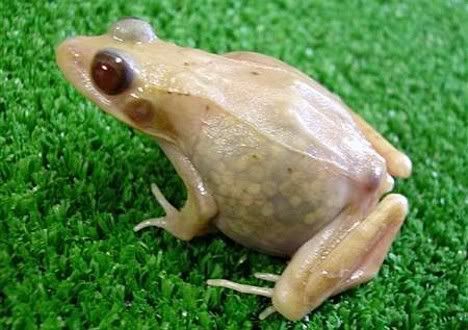
Transparent Frogs

A research team led by professor Masayuki Sumida at Hiroshima University’s Institute for Amphibian Biology has created a type of transparent frog whose internal organs are visible through its skin. The researchers say the see-through frogs can help in the study of diseases and in the development of medical treatments by allowing laboratory scientists to check the status of internal organs and blood vessels while the frogs are alive and without having to dissect them.

(via)