 The axolotl, is a species of salamander. Larvae of this species fail to undergo metamorphosis, so the adults remain aquatic and gilled. (wiki)
Showing posts with label salamander. Show all posts
Showing posts with label salamander. Show all posts
Cute or not? Axolotl
The axolotl, is a species of salamander. Larvae of this species fail to undergo metamorphosis, so the adults remain aquatic and gilled. (wiki)
The hellbender
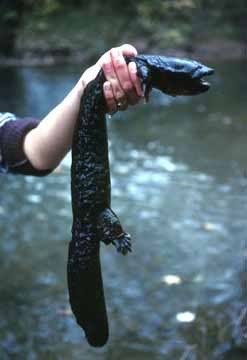
Which salamanders have four legs, a flat head, a paddle-like tail, beady little eyes and are called names like "snot otter" and "devil dog"?
Also known as Allegheny alligator, mollyhugger, and mud cat, the hellbender (Cryptobranchus alleganiensis) is North America’s largest salamander, reaching lengths of nearly 30 inches.
These strange, but interesting creatures once thrived in thousands of pristine streams throughout the eastern United States. Populations have drastically declined, mainly because of declining stream quality. Not only has the hellbender population dwindled by 80 per cent in the last 30 years, but those remaining have severe deformities – missing toes, limbs and open sores. There is a 95 per cent chance of extinction of this animal over the next 75 years.
The average age of Cryptobranchus in the wild is unknown, but in captivity, they have lived as long as twenty-nine years.
Hellbenders are not venomous, though their skin secretions are somewhat toxic. They will bite, but only if they are really provoked. A common myth is that hellbenders will 'ruin' good fishing streams by eating all the fish. This couldn't be farther from the truth! In fact, if you see hellbenders in a stream, this is an excellent indication that the water quality is still good -- and this is good for both hellbenders and game fish. The hellbender's voracious appetite for crayfish also means that they are very important for keeping a stream's food chain balanced, and this is good for fish and the entire ecosystem.
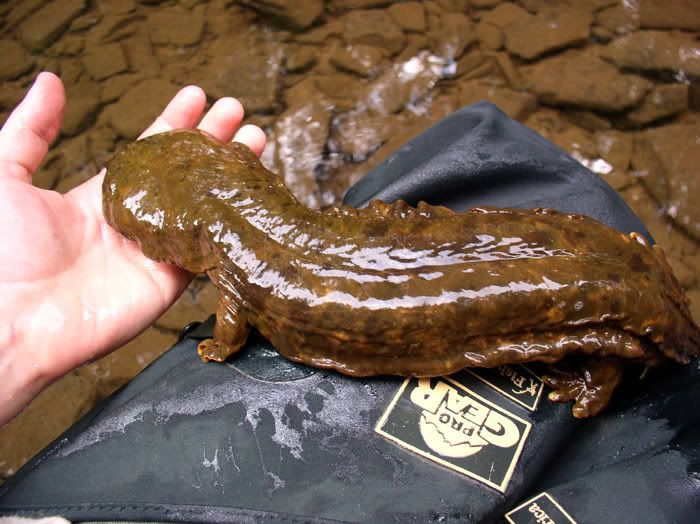
Photo #1: Kurt Buhlmann
Photo #2: Jeff Humphries
Tunnels to prevent carnage of Canadian salamanders
In the early 1990s, local volunteers lifted about 1,200 of them over the bump through two rainy April nights. Then, park staff knocked down a curb so the animals were able to scale it to cross the road. But they're still being squashed by cars and trucks. The mortality rate has been estimated at 10 percent to 40 percent, so now the federal parks agency plans to install tunnels under a stretch of highway at a cost of about C$40,000 ($38,000) to end years of carnage among the long-toed salamander of Waterton Lakes National Park in southern Alberta.
The world's most explosive tongue

The salamander Bolitoglossa dofleini can flick out its tongue more than half its body length in about 7 milliseconds, or about 50 times faster than an average eye blink.
Stephen Deban of the University of South Florida and his colleagues used high-speed video cameras and electrodes implanted in the salamanders’ tongue muscles to monitor the animals as they launched at live crickets.
The findings revealed the tongues were propelled outward much faster than could be achieved by muscle contraction alone.
The researchers think that still unidentified elastic tissue attached to the salamander’s tongue stores up energy in preparation for an explosive action.
Deban likens the process to stretching and shooting a rubber band: the recoil occurs faster than the act of releasing a rubber band pulled taut.
“The amount of energy doesn’t change; it’s just released faster,” Deban told LiveScience.
How the salamander achieves its record power output is still unclear.
Subscribe to:
Posts (Atom)


