Showing posts with label deer. Show all posts

Interspecies love : A deer & a goose

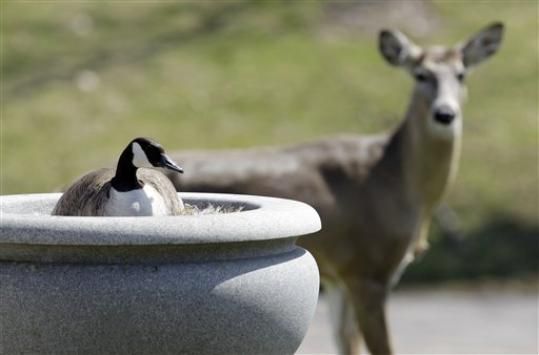
BUFFALO, N.Y.—An unusual springtime friendship between a deer and a nesting goose appears to have blossomed inside a cemetery in Buffalo, N.Y. For the past week or so, the deer has been standing near an urn where the goose has taken up residence, positioning itself between the urn and any passing car or foot traffic.

There is no mate around the goose and and it seems that the deer has taken over the job of protecting the nest.

Source
AP Photo/David Duprey

Savage deer attacking dogs in UK

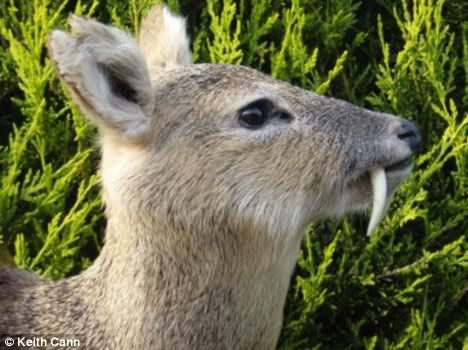
An increasing number of dog-owners in rural Bedfordshire are reporting attacks by Chinese water deer, whose ancestors escaped Woburn Safari Park.

Although the deer are less than 2ft tall and weigh a maximum of 31lb, the males have a secret weapon - downward-pointing fangs which can grow more than 3in long.

The Chinese water deer population had sprung up since they began to escape in the 1920s and 1930s. They breed throughout the year and are quite a menace. You don't normally see them except at dusk because they lie down during day as their natural coloring camouflages them in the long grass.

The UK is now estimated to be home to a quarter of the world's Chinese water deer population.

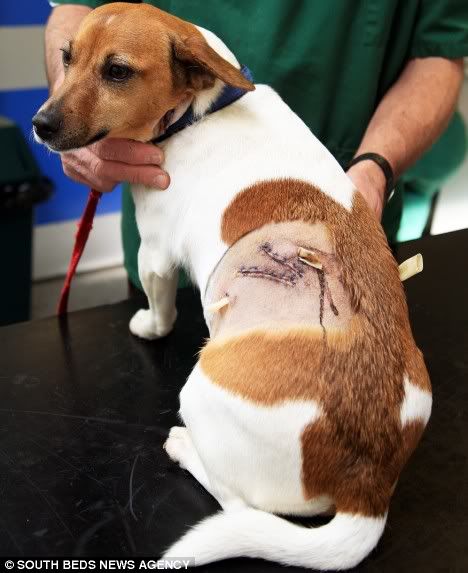
Latest victim was Perdita, a six-year-old Jack Russell out for a walk with Georgina Robey, 12, and her ten year old brother Daniel. Perdita suffered cuts on her back, neck and both sides of her stomach after an encounter with a

Source

Deer or condors - you pick

Chinese conservationists are in a fix over endangered condors eating large numbers of a protected species of deer in a reserve in the north of the country.

More than 100 young spotted deer have been eaten by the condors so far this spring at the Luanhe River National Nature Reserve in Hebei province, near Beijing,becoming an "unanticipated" part of the food chain.

Nationally, the condor is considered far more endangered than the deer.

"The raptors are growing in number and threatening to catch larger animals, like elk, in the reserve," it quoted wildlife official Zhou Changhong as saying.

The reserve only has 600 or so deer and just 10 elk, the report added.

"An adult condor has a wingspan of more than two metres, and not even wardens can frighten it," Zhou said.

Source

A deer little handful

This tiny muntjac fawn was born three weeks early after his mother was hit by a car.

The little orphan, delivered by Caesarean section, was just six inches tall and, at 500 grams, weighed little more than a bag of sugar.

It looked like he, too, would face a tough fight for survival.

But staff at Tiggywinkles Wildlife Hospital in Buckinghamshire believe Rupert, as he has been named, will make a full recovery after his dramatic arrival.

At five days old, he is being kept in an incubator and has just opened his eyes.

Source: Mail Online

Dropping in for a coffee

Frightened by the noise of thunder from summer storms, a wild deer brought chaos in Bolzano, Italy.

The deer sent cafe patrons scrambling as it raced through the center of town. The deer leapt over tables, broke a window, and injured two people.

Several police officers, hunters and the local fire brigade tried for two hours to catch the animal, which was eventually shot dead in a car park by local forestry officials.

Source: Telegraph

Legs to spare

Veterinarians at a north Georgia college have been treating an odd-looking deer after it was attacked by a dog.

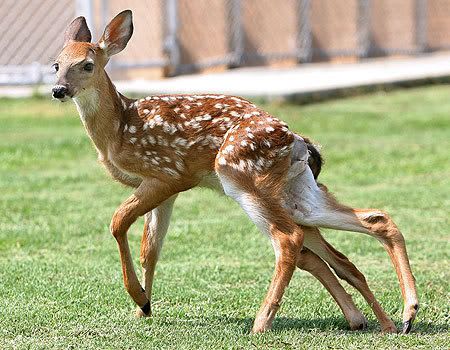
The deer, according to vets at Berry College, has six legs and was found over the weekend near Rome, GA. The animal is recovering from wounds it suffered in the attack.

Due to the injuries, one of its two tails had to be amputated. The fawn has two distinct pelvises and uses one leg from each pelvis to walk.

• Click here to watch video of the six-legged deer.

Source: Fox

Rare births at the LA Zoo


Two male peninsular pronghorns were born at the L.A. Zoo on March 25, 2008. These fawns are the first of their kind ever born at a Zoo. According to Senior Animal Keeper Kelley Greene, “the brothers have been pulled for hand rearing to ensure that they are given every opportunity to thrive.” When the pair is old enough, they will be sent to the Living Desert in Coachella Valley, Calif.

The parents of these two healthy boys were just fawns themselves when they arrived at the L.A. Zoo in July of 2006. These pronghorns originally came here from a breeding center in Mexico and are the first of their species to be on exhibit outside of their home country. The older pronghorns are located in the North American section of the Zoo.

Typically, a pronghorn mother will have one or two fawns weighing in at around seven or eight pounds. When they reach adulthood, pronghorns weigh up to 125 pounds and reach a height of 35 inches. The females are usually 10 to 25 percent smaller then males.

Newborns take their first steps within 30 minutes of birth. By the time they are four days old, they can outrun humans. After just a week, fawns can run faster than dogs and horseback riders over short distances. They are the second fastest land mammal and the fastest ungulate (hoofed mammal), clocking in at anywhere from 40 to 60 miles per hour. They can maintain this speed, without showing any sign of distress, for an hour or longer.

In the wild the fawns will hide for the first three or four weeks of their lives. During these weeks, they come out only to nurse. The fawns will continue to conceal themselves until they are able to move with the rest of the heard.

These graceful animals are mostly active at dawn and dusk, which is when they graze on various plants including, shrubs, weeds, cacti, sagebrush and grasses. Although they will drink when water is available, they can go for weeks without water since they obtain moisture from their food.

The birth of these two pronghorns is a great leap for the conservation efforts of this critically endangered species. Native to Baja California Sur, Mexico, only about 200 of these species survive in the wild. Hunting, cattle ranching and agriculture have resulted in the significant decrease of this species.

In late 2005, seven years after a captive breeding facility was established in Mexico, the first 25 peninsular pronghorns were reintroduced to life in the wild.

The Los Angeles Zoo is partnered with the Vizcaino Desert Biosphere Reserve and the Mexican Government in the Peninsular Pronghorn Recovery Project (PPRP). Since 2000, the Zoo has provided both financial assistance as well as personnel support to the PPRP. The Zoo’s breeding herd is a part of nationwide Species Survival Plan for peninsular pronghorns.
They found a unicorn

From the Associated Press
This undated photo provided by the Center of Natural Sciences in Prato, Italy, Wednesday, June 11, 2008, shows a deer with a single horn in the center of its head. The one-year-old Roe Deer - nicknamed "Unicorn'' - was born in captivity in the research center's park in the Tuscan town of Prato, near Florence.

He is believed to have been born with a genetic flaw; his twin has two horns.

AP Photo/Center of Natural Sciences

OK - now I can't get THIS out of my head!

How do you do, pudu?

The Brevard Zoo, in Melbourne, FL, released photos Wednesday of a Chilean pudu born at the zoo on May 21. The female is currently about seven inches long and weighs just over one pound. At birth, she only weighted 475 grams.


Born to Lola and Elroy, the newborn is the parents' first offspring together.


The pudu is found in South America in the southern Andes of Chile and Argentina. Habitat destruction by logging and introduction of larger deer into the pudu habitat is threatening their survival.

Source: wftv.com

Animals in the news

***** In the Macedonian city of Bitola, a bear was convicted of theft and damage for stealing honey from a beekeeper. Since the bear had no owner and belonged to a protected species, the court ordered the state to pay the 140,000 denars ($3,500) to the beekeeper for damage the bear had caused to the hives.

***** After two years of debate, the Dutch Parliament voted unanimously yesterday to make sex with animals a crime. Sex with animals and making "animal pornography" now carries a penalty of up to six months jail.

*****The government of Randolph, Iowa, has rescinded a five dollar bounty on stray cats . Instead, the town has agreed to work with animal rescue groups on a catch, neuter and release program.

***** In a bid for privacy, Leanne, the Sumatran tiger at the San Francisco Zoo, licked the video camera being used to monitor her and her newborn cub. To everyone's surprise, Leanne has three new babies, not just the one which had been filmed. The three 9-day-old Sumatran tiger cubs, all males, had their first health exam on Saturday, March 15, 2008. (Photo: George Nikitin, San Francisco Zoo)

***** Daniel J. Collins, 39, of Indiana, is being held on one count each of animal cruelty and battery and two counts of neglect of a dependent. He forced his 7-year-old daughter to kill the family cat by holding a knife in her hand and making her stab the feline. Collins told his 11-year-old son and daughter he wanted them to "learn how to kill."

***** Delta Flight 4704 was delayed more than five hours at the Des Moines International Airport on Thursday morning because of a mouse. Crews set up traps with peanut butter on board the plane when a flight attendant was too frightened to fly with the mouse onboard.

***** In Church Hill, TN, investigators are searching for whomever poured deer urine into an air conditioning unit at a school in eastern Tennessee. About a dozen students became ill after the prank at Volunteer High School.

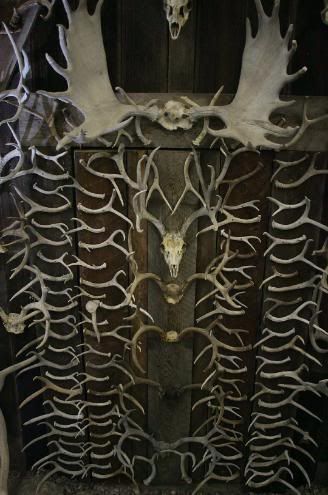
The shed hunter

Jim Phillips is a hunter. He doesn't stalk deer though, just their antlers. Jim has been hunting and collecting shed antlers for more than 50 years and has amassed a collection of 14,500 pieces.

The Antler Man enjoys sharing his collection with visitors to his website: Montana Antler Collection

(via)

She was "thrilled"


On this season's deer opener, a Minnesota woman shot one of the rarest kinds around; an albino deer. Mary Rakotz of Avon got the 6-point buck on Saturday in Mille Lacs County.

She said it was thrilling to see the rare animal, but 100 times more exciting to be able to actually take it home.

"I had heard that it might be in the area, so I thought that here was my chance of a lifetime. So I had to creep a little bit, probably about 40 yards, to get a good place where I could steady myself a little bit. But then I did that and shot and it went right down," said Rakotz.

(Albino deer are so uncommon that it's actually illegal to hunt them in at least seven states.)

Is it any wonder that so many creatures have been hunted to extinction with idiots like this in the world?

Pool Party


Bob and Judi Olwine's home in Woodstock, near Patapsco Valley State Park, is where the deer play.

Judi and her husband decided to do what any baffled suburban couple would do in this situation: They got rifles from the hall closet and ...

Just kidding!

Was that d-e-e-r or d-e-a-r?

Fifth-grade students in a vocabulary class in Aberdeen, N.J., got an unexpected lesson in animal sciences when a deer crashed through their classroom window.

Teachers Brenda Adelson and Bonnie McCullough had just moved from the front of the room when the buck burst in at 10 a.m. Tuesday, the Asbury Park (N.J.) Press reported.

The deer trotted through the classroom into a hall, into the vacant nurse's office, the staff lounge and finally into the empty cafeteria of Lloyd Road Elementary School.

Video: Chow Time

In this video, two men sit down an have dinner with a herd of deer.

We're not advocating this ...

In Illinois the ban on feeding wild deer has been in place since 2002 to help prevent spread of chronic wasting disease (CWD) in the Illinois wild deer herd.

But it's an interesting video to waste a few minutes on.

Mule Deer Moms Rescue Other Fawns

A new study from the University of Alberta and the University of Lethbridge shows that mule deer females, even those who are not mothers, respond to the recorded distress calls of other fawn species, as well as their own.

An intriguing study of mule deer and whitetail deer showed that both species responded to the recorded distress calls of fawns, similar to the responses elicited when coyotes attack fawns, with mule deer mothers responding to both whitetail and mule deer calls, even when their own fawn stood next to them.

In contrast, the whitetail mothers responded only to their own species' call, and only when they could not see their own fawn.