Showing posts with label space. Show all posts

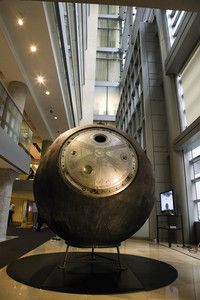
Soviet dog’s space capsule could fetch $10 million at Sotheby’s

The Vostok 3KA-2, a giant rusty ball, orbited the Earth on March 25, 1961. It carried a life-size cosmonaut mannequin and a live dog, and landed two hours after launch in a snow-blanketed field about 700 miles from Moscow.

Three weeks later, cosmonaut Yuri Gagarin climbed into an identical vehicle and became the first human to travel into outer space.

The test capsule could fetch as much as $10 million when auctioned on April 12, the 50th anniversary of Gagarin’s voyage.

The four-legged cosmonaut traveling on 3KA-2 was named Zvezdochka and fared better than some of her canine predecessors just by surviving. The documentary footage played at Sotheby’s shows the dog looking alert, if slightly out of breath, when removed from the capsule.

Sotheby’s offered the test capsule in 1996, with an estimate of $800,000 to $1 million. It didn’t sell and was later acquired privately by an anonymous U.S. businessman directly from the Russians.

Source

- . - . -
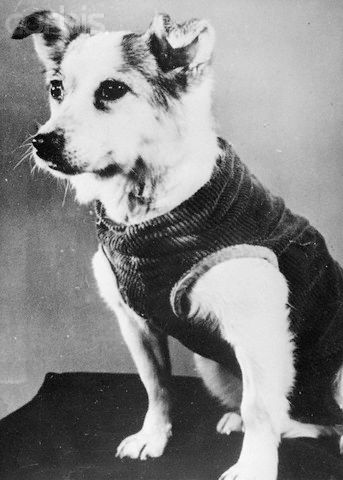
Zvezdochka photo from Corbis

"The dog shown is "Zvezdochka" (Little Star), one of Russia's "Space Dogs," which was reportedly launched and returned safely to earth upon command, in a five-ton Soviet space vehicle, on March 25th. This was the fifth such vehicle to be successfully put into orbit by the Russians, in their attempt to put a man into space and return him safely. The soviet news agency, TASS reported that the dog "feels normal." The main purpose of the launching was "the further improvement of the design of the satellite spaceship and its system" for putting a man into space and returning him to earth."
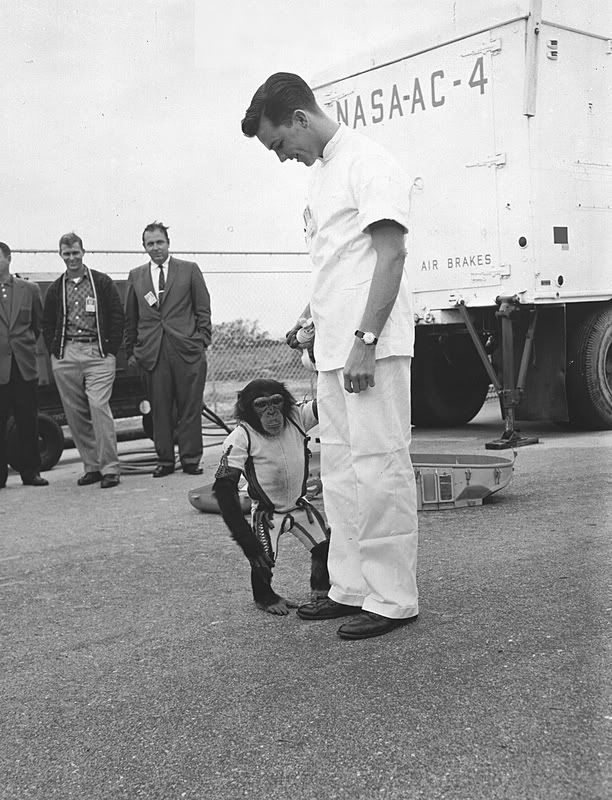
Ham, the first chimpanzee astronaut


Ham, the first chimpanzee ever to ride into space is shown off by his animal trainer on January 31, 1961, at Cape Canaveral, Florida.

Ham was brought from the French Camaroons, West Africa, where he was born July 1957, to Holloman Air Force Base in New Mexico in 1959.

On January 31, 1961, Ham, whose name was an acronym for H olloman A ero M ed, became the first chimpanzee in space, aboard the Mercury Redstone rocket on a sub-orbital flight.

The spacecraft carrying Ham reached an altitude of 157 miles and a speed of 5857 mph. Ham performed well during his flight and splashed down in the Atlantic Ocean 60 miles from the recovery ship. He experienced a total of 6.6 minutes of weightlessness during a 16.5-minute flight.

Ham was placed on display at the Washington Zoo in 1963 where he lived alone until September 25, 1980. He then was moved to the North Carolina Zoological Park in Asheboro. Upon his death on January 17, 1983, Ham's body was preserved and loaned by the Smithsonian Institution to the International Space Hall of Fame in Alamogordo, New Mexico.

Source: NASA

A Brief History of Animals in Space

Before humans actually went into space, one of the prevailing theories of the perils of space flight was that humans might not be able to survive long periods of weightlessness.

American and Russian scientists utilized animals - mainly monkeys, chimps and dogs - in order to test each country's ability to launch a living organism into space and bring it back alive and unharmed.

This article highlights of the history of animals involved in space flight, mostly monkeys, mice, and dogs. Also described are the early attempts with animals in sCreatepace flight, the first chimpanzee in space (Ham), the expansion of species in space (such as an Apollo flight that recorded spiders' attempts to spin webs in space), and other notable history.

Source: NASA

(via)

50 years of dogs in space

A dog named Laika lies within the Sputnik 2 spacecraft during preparations for her 1957 launch. Laika was the first living creature sent into space, but lived for only a few hours after launch due to the failure of the satellite's thermal control system.

November 3 marked the 50th anniversary of a milestone mission — the Russian Sputnik 2 launch that put a dog named Laika into orbit.

Laika's flight marked the beginning of a pilgrimage that has brought terrestrial life forms to the moon and very likely far beyond. That pilgrimage will only expand in the coming decades, and will surely have far wider significance than it has to date.

(via)