Showing posts with label history. Show all posts

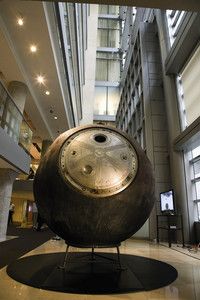
Soviet dog’s space capsule could fetch $10 million at Sotheby’s

The Vostok 3KA-2, a giant rusty ball, orbited the Earth on March 25, 1961. It carried a life-size cosmonaut mannequin and a live dog, and landed two hours after launch in a snow-blanketed field about 700 miles from Moscow.

Three weeks later, cosmonaut Yuri Gagarin climbed into an identical vehicle and became the first human to travel into outer space.

The test capsule could fetch as much as $10 million when auctioned on April 12, the 50th anniversary of Gagarin’s voyage.

The four-legged cosmonaut traveling on 3KA-2 was named Zvezdochka and fared better than some of her canine predecessors just by surviving. The documentary footage played at Sotheby’s shows the dog looking alert, if slightly out of breath, when removed from the capsule.

Sotheby’s offered the test capsule in 1996, with an estimate of $800,000 to $1 million. It didn’t sell and was later acquired privately by an anonymous U.S. businessman directly from the Russians.

Source

- . - . -
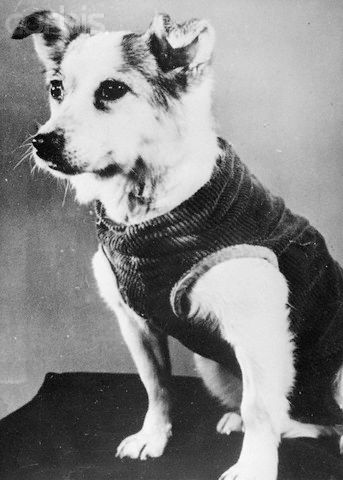
Zvezdochka photo from Corbis

"The dog shown is "Zvezdochka" (Little Star), one of Russia's "Space Dogs," which was reportedly launched and returned safely to earth upon command, in a five-ton Soviet space vehicle, on March 25th. This was the fifth such vehicle to be successfully put into orbit by the Russians, in their attempt to put a man into space and return him safely. The soviet news agency, TASS reported that the dog "feels normal." The main purpose of the launching was "the further improvement of the design of the satellite spaceship and its system" for putting a man into space and returning him to earth."
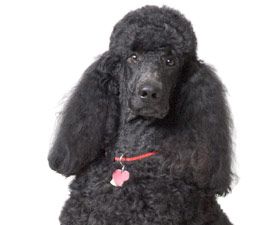
World's oldest known dogs from France were poodle-sized

The oldest dogs from France were small, lap-sized canines that lived up to 15,000 years ago, according to new research.

These poodle-sized dogs raise a lot of questions about the earliest domestication of dogs, due to their impressive age and the fact that most other prehistoric pooches were much larger.

"One or many domestication events could have occurred in France and, more generally, in the western part of Europe," Maud Pionnier-Capitan told Discovery News. She led the French project, described in a paper accepted for publication in the Journal of Archaeological Science.

In 2008, Mietje Germonpre, a paleontologist at the Royal Belgian Institute of Natural Sciences, and her team identified what they believe is the world's first known dog.

Found in a Belgian cave, the remains for this possible dog suggest that it lived around 32,000 years ago and resembled a Siberian husky. But it was about the size of a large shepherd dog.

Germonpre told Discovery News that it's unclear now whether these much smaller French dogs descended from the European Paleolithic stock of large dogs, were introduced from elsewhere, or resulted through selection for a smaller body size.

Read more . . .

Native Americans & dogs - companions in past centuries

The close, personal bonds between humans and their dogs date back centuries in California, according to new archaeological research that illuminates the relationship between the state's Central Valley Indian tribes and their dogs.

The evidence: Central Valley Indians buried their dogs carefully and with ceremony. People and their dogs were often buried together, curled up side by side.

Paul Langenwalter, a professor of archaeology and anthropology at Biola University in La Mirada, Calif, has examined dog skeletons dating back to the 1700s.

"There are no pet cemetery areas, and we don't find the dog burials on campsites or any place where there aren't human burials," said Langenwalter, who specializes in human and dog relationships among California tribes. "They were buried with the people."

Read More . . .

Beauty in the eye of the beholder?

I've had the most fun this morning. Exploring, hunting, learning - THIS is what the internet was meant for, isn't it?

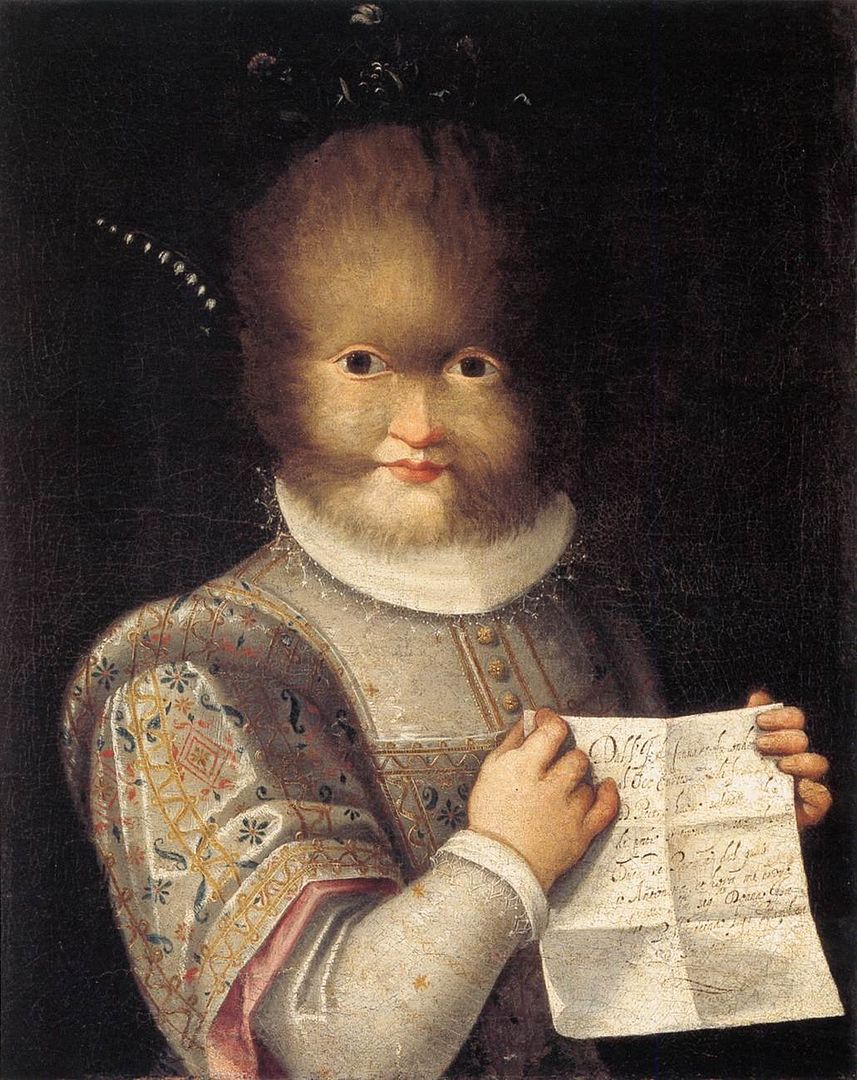
I started at Albert's Window, where the portrait to the left caught my eye.

AND - I had a little moment of Déjà vu. Something about that painting was so familiar. Now, why would such a bizarre piece of art be familiar to me? I thought I'd keep exploring.

The letter which Antonietta Gonzalez the subject of the portrait is holding says,
"Don Pietro, a wild man discovered in the Canary Islands, was conveyed to his most serene highness Henry the king of France, and from there came to his Excellency the Duke of Parma. From whom [came] I, Antonietta, and now I can be found nearby at the court of the Lady Isabella Pallavicina, the honorable Marchesa of Soragna."
Now I detoured to Wikipedia, to read about hypertrichosis, also known as "werewolf syndrome." There, I learned that Antoinetta's father, Petrus Gonzales, has gone down in history as the first recorded case of hypertrichosis.

There are more recent people who are afflicted with hypertrichosis, but they unfortunately are ostracized, or treated as freaks of nature and put on show in traveling carnivals. This was not the fate of Petrus Gonzales and his children.

In Failure Magazine, Merry Wiesner-Hanks, author of “The Marvelous Hairy Girls”, states that,
"They lived at court and Petrus and his sons were given minor positions, Petrus being an assistant bearer of the king’s bread. The Gonzales family was at court because of their hairiness, in a situation similar to that of court dwarves. They were not exactly free to come and go as they pleased, but they were not slaves. Their noble patrons dressed them in luxurious clothing."
In reading an article which Merry Wiesner-Hanks wrote for National Sexuality Resource Center (NSRC), I was thrilled to see that the portrait of Antonietta Gonzales now hangs in the castle of Blois in France.

Then, I had that "Aha moment." See, I've visited Blois! In 2006, we made a trip to France to visit some of the Chateaux of the Loire Valley. I had visited the Chateaux of Blois and had seen that painting before! It just took me about four and a half years to learn its history.

I'm so glad that I did!

(click for larger)
Portrait of Antonietta Gonzales
, by Lavinia Fontana

An unusual painting

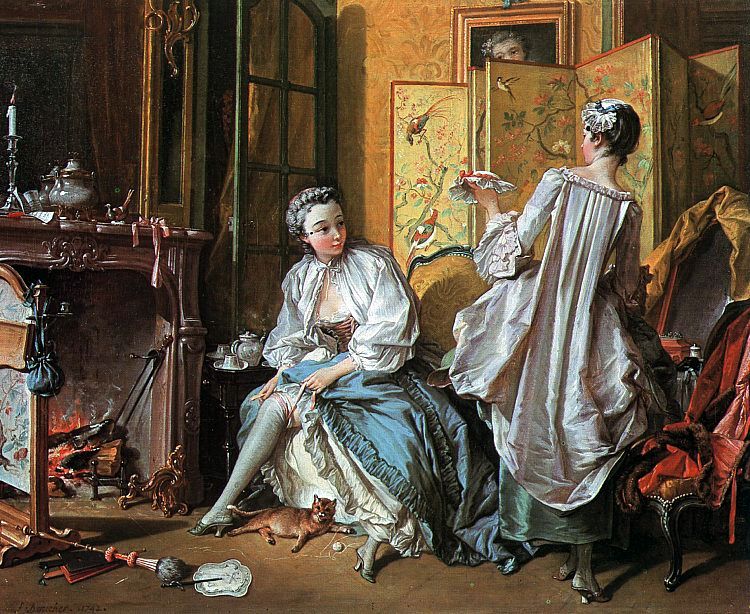
While we often see dogs in art, one very seldom finds a cat. Painted many, many years ago - but preserved forever ...

I love this painting:

Francois Boucher, La Toilette (A Lady Fastening Her Garter). 1742, oil on canvas.
Fundacion Coleccion Thyssen-Bornemisza.

(click for larger)

via

Dogs Were Man's Best Friend Even 9,400 Years Ago

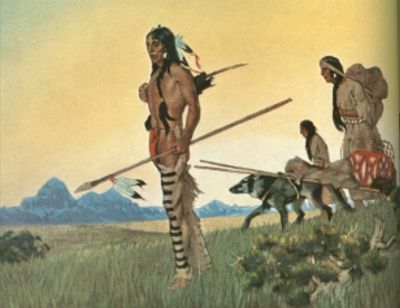
PORTLAND, Maine -- Nearly 10,000 years ago, man's best friend provided protection and companionship - and an occasional meal.

That's what researchers are saying after finding a bone fragment from what they are calling the earliest confirmed domesticated dog in the Americas.

University of Maine graduate student Samuel Belknap III came across the fragment while analyzing a dried-out sample of human waste unearthed in southwest Texas in the 1970s. A carbon-dating test put the age of the bone at 9,400 years, and a DNA analysis confirmed it came from a dog - not a wolf, coyote or fox, Belknap said.

Because it was found deep inside a pile of human excrement and was the characteristic orange-brown color that bone turns when it has passed through the digestive tract, the fragment provides the earliest direct evidence that dogs - besides being used for company, security and hunting - were eaten by humans and may even have been bred as a food source, he said.

Source

You learn something new every day

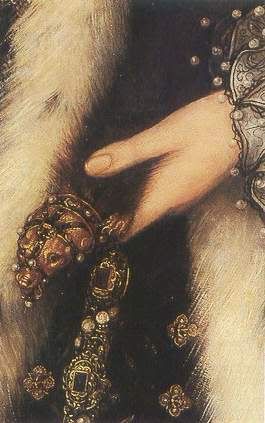
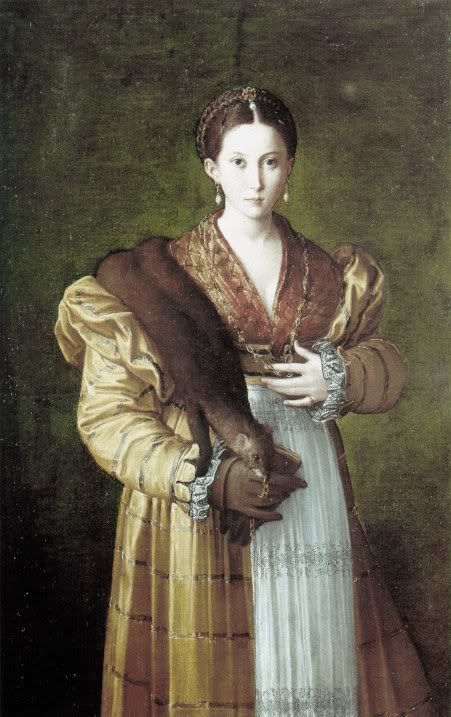
This is a Zibellini, or Flea Fur

Zibellinis were a popular accessory item for noble men & ladies during the 15th and 16th centuries. A zibellino, from the Italian word for "sable", is the pelt of a sable or marten worn draped at the neck or hanging at the waist, or carried in the hand. The plural is zibellini.

Some zibellini were fitted with faces and paws of goldsmith's work with jeweled eyes and pearl earrings, while unadorned furs were also fashionable.

The traditional costume historian's term for this accessory, flea-fur, is from the German Flohpelz, coined by Wendelin Boeheim in 1894, who was the first to suggest that the furs were intended to attract fleas away from the body of the wearer. There is no historical evidence to support this unlikely claim. Italians simply called these accessories "zibellini", their word for sables, and speakers of other languages called them "martens", "sables" or "ermines" in their native tongues.

Zibellini was the entire pelt of an animal, usually marten or sable, but also ermine and lynx were used, and was carried in the hand, over the shoulder or around the neck, and was suspended from a gold chain attached to a girdle. The head and feet of which were often bejewelled replacements for the animals original body parts. There are accounts of clocks being set into the heads. Gold and silver were the norm for the head and feet of the Zibellini, but crystal and jet were also used. Zibellini were further embellished with diamonds, rubies, pearls and enamel work.

The fashion for carrying zibellini died out in the first years of the 17th century, although fox-pelts were worn in similar fashion in the 19th and 20th century. [wiki]

(via Scribal Terror)

How old is that in dog years?

This puppy was photographed in 1845, which would make it 164 years old.

The photo, "Harriet Farnie and Miss Farnie with a Sleeping Puppy, Brownie" is from the National Galleries of Scotland's photostream, now available on Flickr.

Robert Adamson, David Octavius Hill

1920 (original negative around 1845)

Accession no. PGP HA 390
Medium Carbon print
Size 15.40 x 20.20 cm
Credit Elliot Collection, bequeathed 1950

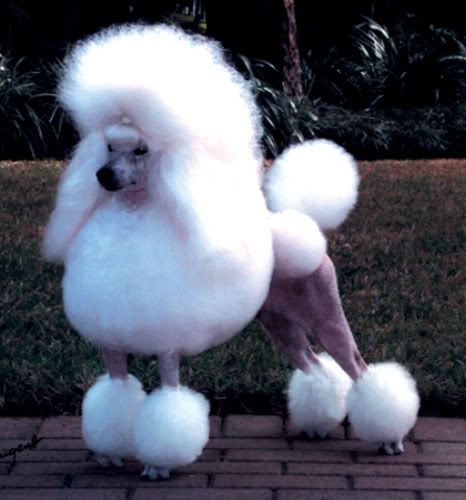
Looking back - origin of the 'Poodle Cut'


Jan at the Poodle (and Dog) Blog posted a great explanation about the origin of the canine hairstyle known as the "poodle cut."

Here's Jan's theory ...

Simpler times

During the next few months, Google will be digitizing the entire LIFE photo archive — about 10 million photos stretching from the 1750s to today.

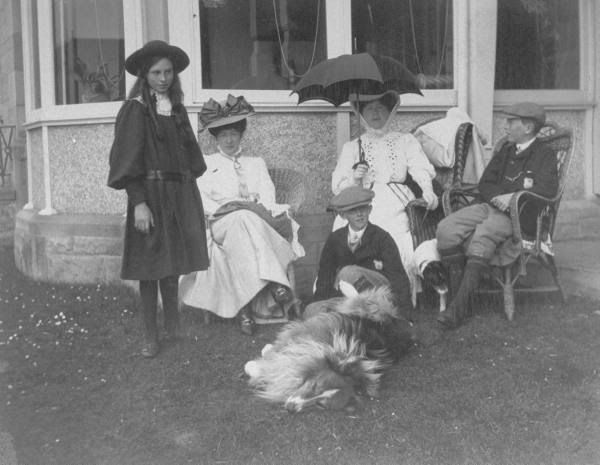
This photo:
Edwardian era group of women, children and pet dog posing for informal portrait outside at resort.
Location:Lossiemouth, Scotland
Date taken:1910
Size:1280 x 991 pixels (17.8 x 13.8 inches)

Takahashi Birds

Yoneguma and Kiyoka Takahashi were among many Japanese-Americans confined in Poston Camp, AZ after the bombing of Pearl Harbor.

While in the camp, they participated in a craft class where they learned to carve and paint small birds.

After their release from the camp, the Takahashis turned their craft into a family business that continued for 40 years.

Yoneguma carved the birds out of white holly wood, starting with a jig saw, then smoothing and sanding the bird. When done, Kiyoka painted the birds (using an Audubon bird book for reference) with watercolors using fine camel hair brushes. 10 coats of lacquer were then applied.

A good day's production was 10 birds. The birds were mostly sold via word of mouth, though a couple of department stores (such as Gump's) carried them. Production was mostly lapel pins, but earrings were also made. Price on the birds in the early days was $2, but in the 1980s, the birds sold for $40.

Initially more than 100 species were made, both male and female, but eventually about 25 different birds were offered regularly for sale.

The grand-daughter of Yoneguma and Kiyoka, Carol Takahashi, has created a website, Takahashi Birds, to honor her grandparents, tell their history, and to give us a glimpse of a time in history that affected many American lives.

(via Hanuman, also Image Event)

Matilda, the Algonquin cat

In the late 1930s a rather disheveled feline wandered into the Algonquin Hotel in New York, searching for food and shelter. Ever the quintessential host, owner Frank Case welcomed the furry traveler into the Algonquin, actor John Barrymore dubbed the bedraggled stray Hamlet, and a tradition was born.

Matilda, the Algonquin's resident cat, just turned 13. A pedigreed ragdoll breed with long, silky, cream-colored hair, she is the hotel's ninth cat since the tradition started. She has the run of the house (except in dining areas and kitchen) but prefers to oversee the comings and goings of the many guests who cross her threshold.

Each year Matilda is given a birthday party, as befits a New York celebrity. A memorable one occurred in 2002 when, while celebrating her seventh birthday with 150 of her closest friends, she jumped on her cake and ran out of the room, leaving a trail of paw prints.

Source: The Algonquin Cat

Photo credit: Eda Cherry

the Dickin Medal

The Dickin Medal was instituted in 1943 by Maria Dickin to honor the work of animals in war.

It is a large bronze medallion, bearing the words "For Gallantry" and "We Also Serve" within a laurel wreath, carried on ribbon of striped green, dark brown and pale blue. Traditionally, the medal is presented by the Lord Mayor of the City of London. It has become recognized as "the animals' Victoria Cross". As of February 2008, it has been awarded 62 times. (wiki)

The Medal, which can only be considered on receipt of an official recommendation, was awarded 54 times between 1943 and 1949. The recipients comprised 32 pigeons, 18 dogs, three horses and one cat.

In October 2000 a Canadian dog called Gander was added to the Roll of Honor. Since then, a further six Dickin Medals have been awarded and all to dogs.

Tthe only cat to be awarded the Dickin Medal is Simon.

Awarded posthumously 1949, the record states that Simon “Served on HMS Amethyst during the Yangtze Incident, disposing of many rats though wounded by shell blast. Throughout the incident his behavior was of the highest order, although the blast was capable of making a hole over a foot in diameter in a steel plate.”

You can read the list of recipients at PDSA Dickin Medal: 'the animals' VC'. You can see more pictures of brave animals at BBC's World's Hero Pets.

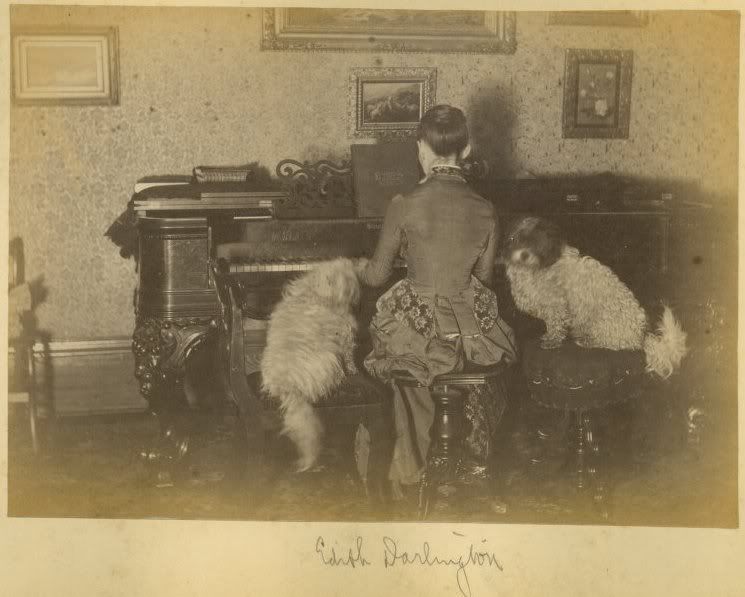
A Curious Audience


From the Darlington Family online collection, at the University of Pittsburg Digital Library, which contains 155 photographs taken by Edith Dennison Darlington Ammon and her brother, O'Hara Darlington, from 1885 through 1888. Photographs contained within the five albums document family, friends, leisure activities, and the artistic approach to photography that both Edith and O'Hara shared.

A Royal dog

Caesar, Edward VII's beloved Norfolk terrier, immortalized by Fabergé in chalcedony, gold, enamel, rubies. He wears a collar inscribed I belong to the King.

The King clearly doted on Caesar, who accompanied his master almost everywhere. Caesar would wag his tail and 'smile cheerfully' up into his master's eyes when King Edward scolded him for misbehaving. Such was their mutual devotion that Caesar wandered the corridors of Buckingham Palace in search of his master in the days following the King's death on 6 May 1910. Caesar's final duty was to walk behind the King's coffin, led by a Highlander, in the funeral procession from Westminster to Paddington on 20 May 1910.

A portrait by Maud Earl painted at this time and entitled Silent Sorrow was reproduced in The Illustrated London News of 21 May 1910. Caesar died in 1914 and is buried in the grounds of Marlborough House in London. A carving of him in marble sits at the feet of the King on his tomb in St George's Chapel, Windsor.

Source: The Royal Collection

Because of a post by The Pet Museum

Maud Earl at Encore Editions

A Brief History of Animals in Space

Before humans actually went into space, one of the prevailing theories of the perils of space flight was that humans might not be able to survive long periods of weightlessness.

American and Russian scientists utilized animals - mainly monkeys, chimps and dogs - in order to test each country's ability to launch a living organism into space and bring it back alive and unharmed.

This article highlights of the history of animals involved in space flight, mostly monkeys, mice, and dogs. Also described are the early attempts with animals in sCreatepace flight, the first chimpanzee in space (Ham), the expansion of species in space (such as an Apollo flight that recorded spiders' attempts to spin webs in space), and other notable history.

Source: NASA

(via)

Old collars, new collars

A unique collection of historic and fascinating dog collars has been built up over the years at Leeds Castle Dog Collar Museum and is now the only one of its kind in Great Britain.

Spanning five centuries, the collection contains examples of collars from fearsome fetters for the great hunting hounds of the past, to canine couture for 21st century pooches.

The collection of over 100 collars and related exhibits was presented to the Leeds Castle Foundation by Mrs. Gertrude Hunt.

The Leeds Castle Replica Collar, sold by Vintage Dogs, has a classic 19th century design of flowers and scrolling acanthus leaves, with a silver wire encircling the top and bottom edges. Each is created in sterling silver, by hand, by the renowned New York City silversmith William Manfredi.

Each collar is priced at $2,400.00, jewels can be embedded by request.

Sick Rams Used as Ancient Bioweapons

Infected rams and donkeys were the earliest bioweapons, according to a new study which dates the use of biological warfare back more than 3,300 years.

According to a review published in the Journal of Medical Hypotheses, two ancient populations, the Arzawans and the Hittites, engaged "in mutual use of contaminated animals" during the 1320-1318 B.C. Anatolian war.

"The animals were carriers of Francisella tularensis, the causative agent of tularemia," author Siro Trevisanato, a molecular biologist based in Oakville, Ontario, Canada told Discovery News.

Also known as "rabbit fever," tularemia is a devastating disease which even today can be fatal, if not treated with antibiotics. Its symptoms range from skin ulcers, swollen and painful lymph glands to pneumonia, fever, chills, progressive weakness and respiratory failure.

50 years of dogs in space

A dog named Laika lies within the Sputnik 2 spacecraft during preparations for her 1957 launch. Laika was the first living creature sent into space, but lived for only a few hours after launch due to the failure of the satellite's thermal control system.

November 3 marked the 50th anniversary of a milestone mission — the Russian Sputnik 2 launch that put a dog named Laika into orbit.

Laika's flight marked the beginning of a pilgrimage that has brought terrestrial life forms to the moon and very likely far beyond. That pilgrimage will only expand in the coming decades, and will surely have far wider significance than it has to date.

(via)