Showing posts with label wolves. Show all posts

Wolves: leave Montana, now!

"If there is a dang wolf in your corral attacking your pregnant cow, shoot that wolf. And if its pals are in the corral, shoot them, too," says Montana governor Brian Schweitzer.

Schweitzer declared he was ready to order state game officials to kill off entire wolf packs in defiance of federal protections under the Endangered Species Act.

In a letter to Interior Secretary Ken Salazar, the two-term Democrat cited his authority as governor to uphold citizens' rights "to protect their property and to continue to enjoy Montana's cherished wildlife heritage and traditions."

Schweitzer said he was driven to act out of an urgent need to assist ranchers and sportsmen left unable to control wolves posing a serious threat to livestock and elk herds.

Source
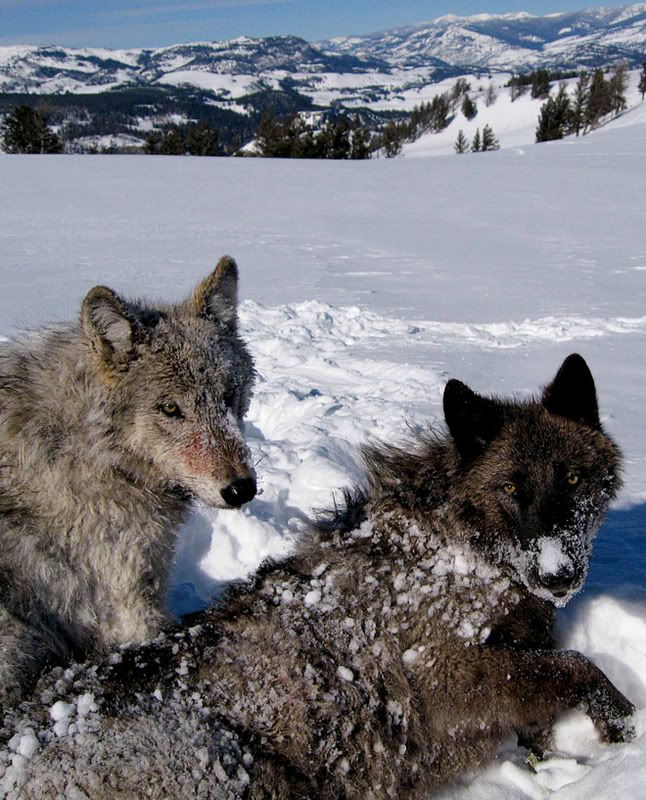
Black Wolves the Result of Interbreeding With Dogs

Biologist Tovi Anderson of Stanford University and her team compared the genes of wolves from Yellowstone National Park and the Canadian Arctic to those of domestic dogs and coyotes. They found that, in each species, the black individuals have the same mutation, which first arose about 45,000 years ago. And molecular-clock analysis showed the mutation was oldest in dogs, suggesting it originated with them and then spread to wolves and coyotes through interbreeding.

This all happened in North America, because there are no black wolves in Europe or Asia (except for an Italian population that has hybridized very recently with dogs). And wolves picked up the black-coat mutation in the distant past, perhaps 12,000-15,000 years ago, when people first crossed the Bering Land Bridge from Asia.

The black coat seems to provide an advantage to forest-dwelling wolves, meaning dogs passed on some useful genetic diversity to their wild cousins.

Source

Video: Dancing On Mother Earth


Clips from the documentary, Dancing on Mother Earth featuring Joanne Shenandoah-contemporary Native American recording artist.
Watch video

Learn about wolves

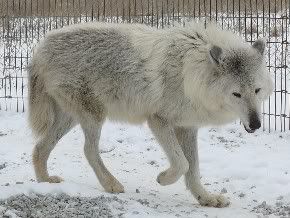
Little Odin was born in the spring of 1994. He is the grandson of the original "Odin", who was the largest known captive wolf in North America.

Little Odin is a British Columbian wolf. British Columbian wolves are primarily black, however Little Odin has grayed out tremendously since he is getting up in age.

Weighing approximately 130 pounds, Little Odin is and has always been the true star of Big Run's presentations!

Beginning as a one-month old pup, Little Odin has helped educate thousands of people and has no less than 650,000 miles under his paws, going to schools, libraries, etc. He is extremely well-behaved, even among crowds. Being semi-retired now, when he stands at the gate and wags his tail, he’s saying that he would like to go to the program that day.

Little Odin lives at Big Run Wolf Ranch in Lockport, IL. Big Run Wolf Ranch is a federally licensed non-profit educational facility specializing in North American wildlife. They have been licensed for approximately 20 years and doing educational lectures for approximately 14 years.

Many of the animals at Big Run have been rescued wherein the only other alternative was euthanasia. Although they have rescued many animals, Big Run's primary objective is education. Currently, they are unable to comfortably house any additional wildlife. They are in the preliminary stages of planning a larger facility to provide homes for orphaned wildlife. Plans include an on-site rehab medical facility as well as an 1800 sq. ft. on-site education center.

Feds sued for taking gray wolves off endangered list

Environmental and animal rights groups are suing the federal government in hopes of restoring endangered species protections for gray wolves in the Northern Rockies.

Wolves in 1974 almost disappeared as a species in 48 US states -- excluding Alaska and Hawaii -- except for some isolated packs in Minnesota and Michigan.

In 1995, 66 wolves were released by the government in Idaho and in the nearby Yellowstone National Park with the hope they would propagate and multiply.

The program was successful. Currently, an estimated 1,200 wolves roam Idaho, Montana and Wyoming.

But now, the U.S. Fish and Wildlife Service has removed the region’s 1,500 wolves from the endangered list in March, turning over management responsibilities to state officials in Idaho, Wyoming and Montana.

Defenders of Wildlife said in a statement that Wyoming and Idaho authorities had given their residents a blank check for the "senseless and indiscriminate killing of wolves."

Source: CANOE

Pronghorn Thrive in Wolves' Shadow

More gray wolves mean more pronghorn antelope in the Yellowstone area, according to researchers who say the region's rebounding wolf population is killing and scaring off coyotes that otherwise prey on pronghorn.

The researchers said that during a three-year study, pronghorn fawns were three times more likely to survive in areas dominated by wolves versus those ruled by coyotes. That's because wolves favor larger prey, such as elk or cattle, and generally leave pronghorn alone.

Source: National Geographic

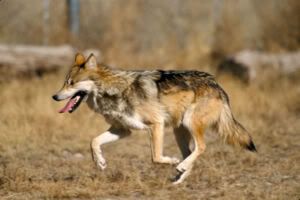
Mexican Wolf (Canis lupus baileyi)


A captive Mexican Wolf (Canis lupus baileyi) at the Sevilleta National Wildlife Refuge, New Mexico, USA. This critically endangered subspecies of the Gray Wolf once ranged from central Mexico to the Southwestern United States. In 1980, the last five known surviving members were captured to save the species. Now, over 300 wolves are taking part in a wolf reintroduction program, with at least fifty individuals in the wild.

Photo credit: Jim Clark, USFWS
(via)

Video: Wolves Fishing

I didn't know wolves could fish. This video is amazing!

Conservation officer: Wolf chased cars

When conservation officer Steve Peterson got a call that a timber wolf was chasing vehicles on a country road near Brimson, he thought it was prank or a misidentified German shepherd. But then he saw it firsthand.

"I couldn't believe it. It was like a dog chasing cars," Peterson said. "It looked like a big, healthy male wolf. No mange."

Responding to the call last Friday, Peterson saw the animal hide in the ditch as a pickup approached and then come bounding out to chase it.

The wolf did the same when Peterson drove to that spot, where he stopped his vehicle.

"He hung around for a minute or 90 seconds and then walked off. I haven't heard any more reports since then," Peterson said.

Wolf dogs find haven in New Hampshire sanctuary


What happens, finally, is you turn a corner – this one being deep in New Hampshire at the bottom of a frost-heaved dirt road over a Western ridge. There is a sign there, crude letters on simple planks. "Loki Clan Wolf Refuge," it says. And you turn that corner and then you see one. You see a wolf. Her name, you learn later, is Wayah. You're here to meet the man who saved her.

In a minute that man, Fred Keating, will watch you watching Wayah, and will begin telling you about her. To begin with, she is not entirely a wolf, despite everything your senses tell you. She's a wolf dog, a mix made by breeding wolves in captivity with dogs. (Wolves won't mate with dogs in the wild.) In most states, Wayah is illegal; in the rest, she's a bad idea for all but a very, very few. "People get them, thinking they'll be pets," Mr. Keating says, "dogs, but cooler. But they're not pets. They're wolves. Doesn't matter if their wolf blood is only 1 percent – that makes them as smart as a 12-year-old human, compared with dogs who are like 3-month-old infants. They're wolves, and that's how they act."