Showing posts with label bonding. Show all posts

How to Bond with Your Cat

By Julia Williams

One of the most prevalent myths about cats is also one that, as a lifelong cat lover, I can unequivocally refute. Cats are said to be aloof, independent creatures that shun humans and don’t form close bonds with them. Many people joke that the only use cats have for people is to keep their food dish full. If that were really true, I imagine there would be a lot less cat owners in the world. Cats can and do bond with humans. This is not to say there aren’t aloof cats among us. There are, yet I believe the vast majority of them are not born aloof but become that way as a result of their environment or lack of human interaction.

Not counting the “family cats” of my childhood, I’ve been a mom to 12 different felines, and have had a close relationship with all of them. Learning how to bond with your cat is not rocket science. It’s more about knowing a few simple things about cats that will help you forge a mutual close relationship.

Respect Your Cat’s Individuality

This is by far the most important thing you can do if you want to have a good relationship with your cat. It’s crucial because cats are individuals and each one has very different likes and dislikes. Moreover, they don’t enjoy being forced to do something they don’t like. Imagine what would happen if you took a child who disliked roller coasters on the Matterhorn ride at Disneyland. They’d scream, cry, kick and make your life miserable. The same principle holds true with cats.

Some cats love being held and hugged, while others don’t. One cat may love having its belly rubbed, while another might think this is a form of torture. If you want to bond with your cat, you need to first learn what it likes and what it doesn’t like. Then you can spend your time doing the things your cat prefers rather than trying to force it to do things it doesn’t enjoy.

Although you may want a cat that enjoys being petted while sitting on your lap, you may actually have a cat that prefers being petted while it’s lying on the bed or the floor. Unfortunately, you get what you get, and you can’t change your cat’s preferences by wishing or by force. This is one reason I love having more than one cat. My three cats all like different things, so I get to enjoy a little of everything. For example, one cat doesn’t like being held or kissed but will sit on my lap for petting, for as long as I indulge him. One likes to be cradled like a baby but is not a fan of the lap. One loves to be brushed while two do not. You get the idea. It’s all about what the cat likes, not what you like!

Spend Time with Your Cat

You simply can’t expect to bond with your cat if you don’t interact with them on a daily basis. This is especially true if you work outside the home and are gone for most of your cat’s day. If you come home, plop on the couch to watch TV and don’t pet your cat or play with them, do you think they don’t notice? It’s preposterous to think that cats don’t have feelings and don’t know when they’re being ignored. They certainly do, and they don’t feel all warm and fuzzy toward the people who ignore them. Greet your cat enthusiastically every time you come home. Engage them in play with their furry mouse or feather toy. Show them that they matter to you, and you may be surprised to see that they actually meet you at the front door!

Talk to Your Cat

Even though your cat will not understand everything you say, they can and do learn certain words. Aside from that, they love hearing your voice and they know that you’re speaking to them and paying attention to them. You can talk to them about anything and everything because what you say doesn’t matter nearly so much as how often you speak to them and are focused solely on them.

These tips are all things I have learned from many years of having cats in my life. I really believe that anyone can form a close bond with their cat if they desire it, and are willing to do a few simple things to nurture the feline-human relationship. When you treat your cat like family, respect their individuality and see them as sentient beings that want to give and receive love, your relationship will blossom.

Read more articles by Julia Williams

Do You Talk to Your Pet?

By Linda Cole

Everyone I know talks to their pet, but I don’t think all pet owners do. However, those who don't believe animals understand our words are missing an important means of communicating – and bonding – with their pet. Research has shown dogs are capable of learning so much more than once thought. And we can learn what our pets’ whines, yaps, meows and barks mean, if we take the time to listen. Of course they don't understand everything we say, but they can and do pick out the words that mean something to them. Conversations with your pet can help you nurture and strengthen the bond between you and your pet.

My cat Jabbers, pictured above, is a handsome black kitty with a splash of white on his chest and huge emerald eyes. He got his name because as a kitten he jabbered constantly, and still does. Jabbers and I have discussed everything from what's going on outside, to a first base umpire who needs glasses, to what's for supper. He doesn't care what our conversations are about, just that I took the time to talk to him, and he's definitely a cat with an opinion, which he freely expresses during our conversations. And he never disagrees with me; well... at least I don't think he's disagreeing. He rolls over on his back and sticks his front legs up in the air and rubs his head against my hand as I talk to him. Then he whirls around and sits up so he can talk to me. I had a cat years ago who would put one of his paws on my cheek every time he talked as if he wanted to make sure he had my full attention.

I can't imagine not talking to my pets. I tell them I'm sorry if I've accidentally stepped on their paw or tail. My Border Collie Keikei and I discuss why she can't herd the cats. And I just recently had a conversation with one of my dogs on the perils of trying to eat the TV remote and why it doesn't belong inside her mouth. Of course they don't understand everything we say, but that's not the reason why we talk to our pets. Our touch and voice are special to them – just as special as when we are touched by or hear the voice of someone we care about. Hearing our voice gives them a comfortable and secure feeling.

Talking to your pet is one way they learn what we expect from them through informal training sessions. My dogs all learned how to back up not because I set out to train them that particular command, but as a result of conversations with them. To keep them from rushing through the door every time we went outside, I was in the habit of saying “back up” as I blocked the doorway. The full conversation was, “Back up so you don't run over me or the cats.” One day it dawned on me how well they all backed up when I asked them to, and how much easier it was to control them. They learned on their own what “back up” meant. It may have happened because of consistent training, even though I didn't consciously train them to back up, but it was also made possible because of talking to them and letting them know how I wanted them to behave. After all, that is what training is all about – communicating with your pet.

Pets are good at picking out and learning specific words we use in conversations with them and with other people in the home. They recognize words that describe things they want, like their favorite CANIDAE treats. Pets understand when we are getting ready to leave or put them outside because of our actions and what we say. Even when you try to confuse a dog by changing the words you use, sooner or later, they will learn those words too. They are so much more observant than we realize and they are always listening to our voice when we talk.

As pet owners, the most important thing we want to always maintain is a positive feeling of us in their mind. I want my pets to greet me when I return home. I want them to sit beside me on the couch or cuddle with me at night. I love those moments because it gives us a chance for some small talk. It doesn't matter if they understand my words or not, they do understand the moment. Talking to your pet is one way to instill that all-important positive attitude in them, along with trust and respect.

Read more articles by Linda Cole

Why Do We Love Some Pets More than Others?

By Julia Williams

I’m not fond of all of the hoopla that surrounds Valentine’s Day. I ignore the stores’ nonstop pleas to “spend, spend, spend” to show my love, because I know I’ve already done that, many times throughout the year. This day does, however, inspire me to reflect on the love I feel for my three Furry Valentines (Annabelle, Mickey and Rocky) and for the others who’ve crossed the Rainbow Bridge. Lately, I’ve been thinking about the special bonds that take place between people and their pets – specifically, what is it that makes us bond more strongly with some pets than others? I’ve genuinely loved all of the eleven cats and one dog that have shared my home, but I’ve bonded with three of them on a much deeper level.

I can think of several reasons why a certain pet might capture our heart so profoundly. A strong bond can develop as a result of how they interact with us, or grow deeper because of how they positively impact our life. Sometimes, though, a strong bond is there from the moment we lay eyes upon an animal. I can completely understand the first two; it’s the last one I grapple with, because “love at first sight” defies rational explanation. I’ve had this phenomenon happen with both a person and a cat, and it’s difficult to put into words. There’s a feeling of familiarity, as though you’ve known them your entire life. Like steel is drawn to a magnet or a moth is drawn to the flame, there’s a forceful pull that’s hard to resist.

Many years ago, I experienced love at first sight with a tiny kitten I saw in a pet shop. It wasn’t that she was just so cute I couldn’t resist. She was actually a bit homely, since her oversized ears made her look like Yoda from Star Wars. It was just a feeling I had, that I couldn’t possibly live without her. But I went home alone, because I wasn’t comfortable buying a pet shop animal. I tossed and turned all night thinking about her, and by the next afternoon I couldn’t stand that magnetic pull any longer. I brought her home and named her Abby. She never did grow into those gigantic ears, but I loved her deeply from day one. 

I bonded with my childhood cat Pepper because his gentle, loving presence gave me stability in a world filled with tragedy, loss and betrayal. The current feline love of my life is my dear, sweet Annabelle. My bond with Belle has always been strong, but it gets deeper year by year because of the way she loves me, and allows me to love her. Belle is an affectionate cat that likes to drape herself over my shoulder and cuddle with me, not for just a minute or two but for long stretches. I hug her close and bury my face into her long fur, and she relaxes into me. She likes to sit on my desk while I write, with one paw touching my left hand. She also loves to be brushed, and gives the best kitty head bonks to say thanks. In bed, Belle snuggles under my chin and purrs herself to sleep.

There’s no doubt in my mind that I mean a lot to Belle, and that she genuinely enjoys being close to me. I’ve never really had an aloof cat, but neither have I had a cat more loving than Belle. I treasure this special bond with my baby girl, and feel so blessed that she chose me as “Mom.” 

I dedicate this post to all of the Furry Valentines in my life… and yours! If you feel like sharing a story about a special pet you’ve bonded with, I’d love to hear it.

Read more articles by Julia Williams
The Inexplicable Human-Animal Bond

By Julia Williams

When it comes to pets, I believe there are three kinds of people in this world: those who have never had a pet and don’t care to, those who enjoy having pets but don’t form particularly close bonds with them, and those who think of their pet as a family member that they would do just about anything for. I find it interesting that my mother is in the first group, my late father is in the second group, and I am in the third group.

Of further intrigue to me is that my sister shares my deep love for cats, while my brother has a cat but only because his children begged for one. This would seem to indicate that the ability and/or the desire to form close bonds with pets is not hereditary, nor is it shaped by your upbringing.

I honestly don’t know where my love of cats came from, but it’s quite clear it didn’t come from my mother or my childhood. Living on the outskirts of a small rural town, we did have an assortment of animals – a dog, some cats, two Shetland ponies, a few cows and chickens – but I don’t remember being especially fond of any of them. That changed when a cat named Pepper came into my life as an emotionally troubled young girl.

If I had to guess, I’d say my deep attachment to Pepper was an attempt to calm the chaos my life had become. Pepper’s presence grounded me and gave me an outlet for expressing the grief and turmoil that boiled inside. I could tell Pepper my deep dark secrets without fear of being judged or ridiculed. I could give and receive love in a way that I simply didn’t feel safe doing with humans. I trusted Pepper explicitly, because I knew he would never, ever betray me. Pepper’s unconditional love and acceptance of me was exactly what I needed to get me through this incredibly difficult time.

My beloved Pepper is long gone, but the bond we shared will never be forgotten. As an adult, I have been blessed to know and love many other cats, and each one has left indelible paw prints on my heart. My cats make this world a better place in so many ways, that the thought of living without them is inconceivable.

I can see, somewhat, how people could fall into the first group – those who have never wanted to have a pet – because they don’t know what they’re missing. However, I can’t fathom how any human being could share their home and life with a pet and not become emotionally attached to them. It’s simply not something I could ever do, nor would I want to be the kind of person who sees pets as an accessory or a possession.

I think many “non-pet” people have a hard time understanding how others could form such deep attachments to an animal. Regardless, I know I’m hard-wired to have an intense, life-changing bond with my pets, and I’m perfectly fine with that. I’ve come to think of pets as “angels with fur,” because they’ve saved my life on more than one occasion. My life is infinitely richer because of the wonderful pets that have graced me with their presence, and I wouldn’t trade those relationships for anything. 

Read more articles by Julia Williams

What Pets Teach Us about Life

By Linda Cole

For years my family and friends have teased me about my love for animals of all kinds. They've accused me of caring more about animals than I do for most people. My pets have seen me at my worst and my best, and have always been there when I needed a friend. The bond we have with pets is unique, and we know what the benefits of owning a pet are for us and children who grow up with a pet in the home. The bond we share with a pet opens our eyes and allows us to learn from them things about ourselves and life. It's been said, “The eyes are a window into the soul” and if you take the time to really gaze into your pet's eyes, you can see more than you think and learn things about yourself. What pets teach us about life isn't found in books; it's found in simple pleasures and the basic needs for life.

Pets have no concept of wealth or power, and are content to live in the moment. If you pay attention to them, they teach us lessons every day. What happened yesterday or an hour ago is forgotten and tomorrow's possibilities are wide open. If the sun isn't shining, it's OK because dancing in the rain can be just as much fun. I've learned the simple things – the freebies of life – are what make it worthwhile. Hiking with your best canine friend by your side, or sitting by a campfire under a star-filled sky away from the noise of the world helps to put things in order. Pets teach us to enjoy the little wonders in life, and that it's worthwhile to look under a bush once in awhile.

Being around dogs and cats my entire life has taught me how important it is to take a deep breath before shouting words in anger. Pets teach us how to forgive and overlook little imperfections we have a tendency to magnify. They don't hold grudges, they don't criticize or belittle, they tell no secrets, they don't judge others and they accept us for who we are – always!

My pets have taught me that responsible pet owners who truly love their pets are special souls. If we find a stray hair in our food, it's alright. A final brush before walking into work will remove most of the pet hair. We don't think about the bit of hair on a chair until after a guest sits down. We don't think twice about tossing a pet's toy off the couch after sitting on it or walking the dog when it's freezing so he can do his business. It's all part of sharing your home with a dog or cat.

Pets teach us it's not important to worry about things in life we can't change. They take it all in stride, which is a lesson worth learning and we can benefit from their innocent curiosity about everyday encounters and surprises.

I love to watch my dogs when they're outside. Their eyes steadily move from a bee on a flower to a bug crawling through the grass to a bird flying over the trees. Noses twitch from side to side as they catch a scent carried in the wind. Ears prick up and rotate back and forth until they get the perfect position for listening to a far away sound. Life shouldn't always be lived in the fast lane. Pets teach us to slow down and listen to nature's song and marvel in the beauty of all life around us, if you take the time to watch and learn.

People can have unflattering attitudes about others and misinterpret words or actions. Our pets teach us to overlook misinterpretations and find the good in others because that's what they see in us. Unconditional love shouldn't be just a pet thing. Living with pets helped me understand just how much I love all animals. I probably do prefer the company of a pet over that of a lot of people I know, because I don't have to pretend to be someone I'm not just to make someone else happy. Life is about choices, understanding, learning and giving. My pets are who I am, and I can't imagine ever being without one.

You can tell what's in a person's heart when you watch them with their pet. The responsible pet owner shares a bond that can't be broken, and you can see it in their eyes and that of their pets. Our pets appreciate the little things in life, and they teach us it's OK to roll in the grass. We just need to take the time to watch and learn from their wisdom about life.

Read more articles by Linda Cole

Positive Reinforcement: The Power of Praise


By Linda Cole

Dogs and cats are social creatures, and they respond to positive and negative interaction with us. Some days it seems like the only thing I say to my pets is no or stay down. It's easy to see things they do wrong and correct them for it, but they also need praise from us – lots of praise. You can see their eyes light up when you tell them how good they are. Positive reinforcement is a powerful motivator for even the most stubborn pet. There is a correlation between a pet's healthy state of mind and praise.

As responsible pet owners, we understand pets need to feel good about themselves just as much as we do. They can pick up on our negativity and respond to us just like we would to a negative person. A pet who is constantly yelled at has no idea how to please his owner or how to know what's expected. What you say, how you say it and the tone of your voice, along with your body language, tells pets everything they need to know about us.

Of course, you can't praise a pet who attacked the garbage container in the kitchen or left a “surprise” on the living room carpet while you were gone, but how those situations are handled makes a difference to pets. Yelling does no good because even though they look like they know why they're being yelled at, they don't. You can, however, give them positive reinforcement without giving them praise. Pets don't do things on purpose to make you angry, but a bored pet will find ways to entertain himself and some pets can only hold it for so long before they give in to their need. The best thing you can do is clean up without saying a word and learn how to prevent future episodes. In your pet's eyes, he did nothing wrong and yelling will only confuse him. Ruthie Bently wrote an excellent article on how to discipline a dog.

Praise is the most effective way to train a dog or cat. Positive reinforcement makes a pet eager to do what's asked of them. A dog will accept any command as long as he knows what you want. Think back when you were in school. Most likely, your favorite teacher was the one who made you feel good about yourself with positive reinforcement. Learning was fun and rewarding, and you wanted to perform well in class because of it. Now, remember the teacher who was always critical and you never knew what they expected from you. Learning was more of a chore and you didn't respect that teacher. It's the same way with pets. You want your pet to have positive thoughts about you, and sincere praise means everything to them.

Positive reinforcement and honest praise creates a pet who accepts you as their leader because you've demonstrated fairness and respect to them. Dogs follow you from room to room because they want to be with you. They sit a little straighter and puff out their chest, their eyes light up and tails wag with enthusiasm when you look at them. Cats purr a little louder and give cat kisses with their eyes. It's at that moment you know you've earned their trust, and it's accomplished with positive reinforcement from sincere praise.

Sometimes pets need discipline, but it can still be accomplished in a manner that doesn't belittle the pet or leave negative feelings in their mind. The only thing hitting, kicking or yelling at a pet will teach them is that their owner is not a leader nor respectful of them and doesn't deserve their trust or respect.

Pets give you positive reinforcement when they curl up on your lap or lay beside you on the couch or next to your chair. Because they want to be with you every chance they get, it reinforces your bond with them. Every time they rub against you or look at you with satisfaction, that's their way of giving you praise.

The power of praise and positive reinforcement is so strong, it can help a dog or cat with behavior problems modify their behavior to one that's more acceptable, as long as you take the time to help them. A responsible pet owner understands what type of praise works best and can use it to maintain their pet's positive state of mind. Dogs and cats need you to show them by your positive actions how you want them to act. By using praise with an appropriate tone of voice, you will have happy, well adjusted pets who do what you ask because they want to, not because they were forced to comply.

Read more articles by Linda Cole

Do Pets Forget About Us Over Time?


By Linda Cole

Sometimes, because of situations beyond our control, we have to find a pet a new home. An illness or change in jobs can force a loving owner to have to give their pet away. We develop such a close bond with our pets, we never forget them. But do pets forget about us over time? There's no shortage of stories recounting the adventures of pets who traveled hundreds of miles to find their family. When a close bond has been broken and pets have to form a new one with a new family, are we still in their mind? Do they forget about us or do they retain some memory of their old life?

My mom fought a lifelong battle with rheumatoid arthritis, and was in and out of the hospital for as long as I can remember, undergoing numerous surgeries to correct the damage caused by her disease. Complications from her last surgery kept her in the hospital far longer than expected. I was taking care of her pets at my house. As their extended stay turned into months, one of her dogs, Ben, began to mope around the house. Mom passed away in the hospital and I started the chore of bringing her belongings to my house. Ben perked up when he smelled familiar scents, and he burrowed under her bedding I had brought over to wash. He ran from room to room as if he were looking for something, and I always wondered if it was simply the smells he remembered or if he was looking for my mom. I do believe he remembered his life with her when he smelled familiar scents from his home.

We know a lot about dogs and cats, but whether pets forget about us when they go to a new home or become lost is still a mystery. But there are amazing examples of how a cat or dog walked hundreds of miles to get back home when they were lost, given away or relocated to a temporary home. A cat walked 1,000 miles through the Australian outback to return to his home after he was taken to stay temporarily with a family member while his owners were overseas. What's truly remarkable is how he knew which way to go, and that he survived in a region where many people have trouble surviving. It took him a year to cover his 1,000 mile trek home!

A well known example of a dog who refused to leave his master's side is Greyfriar's Bobby, a Skye terrier who became a fixture on his owner's grave for 14 years. Even though people in the community tried to adopt Bobby, he always ran away and returned to the cemetery.

Some pets seem to be more tuned into their owners than other pets. We know some dogs have the mental capacity of three year olds. Cats are much smarter than they're given credit for, and some dogs and cats do exhibit problem solving abilities. We can remember significant things that happened when we were three. So why should it surprise us if some pets can remember?

If pets do forget about us over time, then how do we explain the ones who crossed rivers and mountains to return to their homes? Some have even left their old home to find their owner who moved to a new location that was unfamiliar to the pet and yet, they were able to find them.

No one knows how pets are able to do this. It really is amazing how some pets are so connected with their owners that they will go in search of them. Some accounts of pets returning to their old home could be due to the pet wanting to be in familiar and comfortable territory. But that wouldn't explain why a pet would pull up roots, leaving their old home to go in search of an owner who moved hundreds of miles away or one who passed away.

Pets instinctively hide pain or injuries so they don't appear weak. Is it possible they're good at hiding their feelings as well? Love is a hard emotion to define when it comes to our pets. We love them, but do they love us in return? I think they do. Do pets forget about us over time? It probably depends on the pet. Some are willing to do whatever it takes to be with the ones they feel comfortable and safe with. Love, after all, is a comfortable and safe feeling. Maybe it's that simple for some pets – it’s a familiar bond with their human that remains no matter where we are.

Read more articles by Linda Cole

How Dogs Make a Difference in Our Lives


By Linda Cole

I've had the honor of sharing my home with multiple dogs over the years. Some were ones I picked out, but most had been abandoned. I've never regretted adopting dogs or cats who needed a home. Every now and then, one will touch your heart more than others. Two dogs who found their way to us were special souls that made a difference in our lives.

Rosie had been found with her brother dumped in a ditch in early January. Around here, that's a death sentence for 8 week old puppies trying to survive with no shelter or food. I remember the afternoon I picked Rosie up from the people who had found her. She was smaller than my cats. Pushing her nose inside my jacket, she cuddled against me as I wrapped her inside my coat. She shivered as we walked out into the cold air. As I climbed into the car, she crawled over and snuggled against my leg laying her head on my lap. She didn't make a sound or move from her spot as I drove home.

The little red pup quickly grew, and grew, and grew. In fact, I was beginning to think we had adopted a small horse instead of a dog! Rosie didn't waste any time settling into her new home. She rarely barked, preferring the more melodic tone of a howl, and she expressed her opinion loud and clear. She always had the last word to say about everything on any subject, especially when she didn't want to do something or move out of the chair she'd claimed.

She was as gentle as they come. We were finally able to reassure her when we left the house to go to work, that we would be back. I always wondered if she remembered being abandoned in that freezing ditch. Rosie never liked winters and shivered through the cold months.

About a year after we adopted Rosie, a friend of ours had been visiting a friend and her boyfriend. She watched as the guy yelled at, kicked and hit their dog before throwing it against the wall in a fit of rage. My friend angrily told them they didn't deserve to have a dog. Having no collar, she wrapped her shoelace around the dog's neck and left. No pets were allowed in her apartment and after telling us her story, we agreed to take the dog. She was around 9 months old with no name.

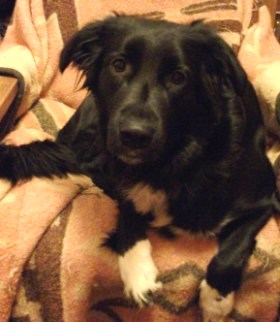
It didn't take us long to discover how loving and special she was, so we named her Angel. She was a beautiful black Border Collie mix with the kindest eyes I've ever seen. Angel loved herding my cats and she was good at it. The cats, however, weren't too fond of it. She loved playing catch with a ball or Frisbee and her favorite thing to do was head out to a nearby lake and retrieve tennis balls thrown into the water. Eager eyes waited for me to throw the ball and she'd watch it soar, timing her splash into the water at the same time the ball hit. She'd grab the ball, race back to drop it in my hand and then streak back to the lake as the ball sailed through the air. I loved taking her to the lake because I knew how much she enjoyed it.

Considering how badly Angel had been abused, we were surprised with how gentle she was with us and the other pets. One day when becoming overly excited during a baseball game, I noticed Angel cowering in the corner of the living room trying to make herself as small as she could. She was wide eyed and shaking like a leaf. Tears came to my eyes when I realized my yelling at an umpire had frightened her. I'll never forget that image because I realized she hadn't forgotten how loud voices affected her and in her mind she associated yelling with pain.

There's a special bond that develops with a pet who was abused or abandoned before they came to you. You want to hold them close and make sure nothing bad ever happens to them again. But you can't do that. The best thing you can do is give them stability by treating them like everyone else. That's all they ask of us. Dogs or cats don't worry about the past. They move on and that's what we have to do in order to help them. Time and love will heal most things, but the actions of cruel people are hard to forget. All living things feel pain and react to violence and negative emotions. I hope to never run across another dog who experienced what Angel did.

Read more articles by Linda Cole

How Well Do You Know Your Pet?


By Linda Cole

Our pets are as individual as we are. They have their own little quirks and preferences. They don't always follow what the experts say and they may or may not come when called. Understanding your pet on an intimate basis is important because during times of stress, you have a better idea of how they might deal with events that upset their normal routine. Our pets are creatures of habit and getting to know them well is as important as knowing a close friend. It's possible your intimate knowledge of your pet's personality could actually save their life during an emergency or if they were to ever become lost. Do you know your pet well?

How many times have you heard someone say, “He just wasn't acting like himself?” Most likely he was, it was just a side others hadn't seen before. Pets are the same way. It's easy to learn and understand a dog's body language and what their bark is saying. Your cat's swishing tail will tell you it's time to leave them alone and you know by their yowls if you are late with their supper or if they want inside or outside. It's also important to understand their moods and the subtle looks they give you that sets them apart from other dogs or cats. When you know your pet well, it's easier to understand why they do specific things.

Does your pet have a favorite room in your home? If they are upset, scared or not feeling well, do they hide under the bed, in a closet, under the recliner or someplace where you can't find them? Does your cat like to catch up on what's going on in the neighborhood from a certain window? What's your pet's favorite game or toy? Do you know when they want to play or go outside? Did you notice how much your dog enjoyed going on a hike with you? Is your pet comfortable around strangers or in unfamiliar surroundings? Do loud noises or storms make them nervous?

Some pets are more sensitive than others. They do get hurt feelings and will pout. They can also get mad at us and can display their anger via behavioral problems. If you know your pet well, it's easy to see how things you do or changes you've made can affect them. They don't have a vote in our decisions, but they do let you know how they feel about it in their own way.

My twelve year old cat, Taylor, decided one day she didn't want to eat with the other cats anymore. She started to hide under the bed at meal times. The other cats intimidated her and meals had become traumatic for her. She would hiss and growl and wildly attack anyone close to her, including me. After a checkup with the vet revealed no medical reason for her actions, I was able to help her best by changing where she ate her meals. Some cats just prefer to eat alone. My work schedule had also changed and she wasn't able to curl up next to me like she'd been accustomed to. She now eats in peace in my office while I work which is in a room away from the other cats, and she's able to get the extra attention she craves.

When you know your pet well, there is a bond that continues to strengthen. The trust and loyalty your pet gives you is special. They will be by your side no matter who you are, where you go or what you do. Rich or poor, they will give us everything they have and expect nothing in return. Pets are always happy to see us no matter how long we've been gone.

Our pets do have feelings and fears, and we can hurt their feelings and miss their fears. They look to us to be their rock in good times and bad. Pets can sense our emotions and read our body language, and they love us unconditionally in spite of our faults. They react like children to our outbursts and cower or hide if they think they're in trouble. They don't reason the same way we do, but they do understand more than they are given credit for.

When you know your pet well, you see them for who they are – imperfect beings just like us. If you haven't gotten to know your pet, there's no time like the present. You might be surprised by what you learn. Having an intimate relationship with your pet says a lot about you, and benefits both you and your pet.

Read more articles by Linda Cole

Benefits of Hiking With Your Dog


By Linda Cole

To me, spring and fall are the best times of the year to go hiking with your dog. Spring breathes new, fresh life into trees and wildlife. The land is once again colored with green grasses and spring flowers. Autumn gives us beautiful colors in different shades of orange, golden yellows and reds that enhance a hike through the woods or along trails. A change is in the air. Gone are the sticky, hot temperatures of summer! Fall is a great time to head out to your favorite trail and enjoy the benefits of hiking with your dog.

Even the most hardened four legged couch potato loves to get outside for much needed exercise. The problem with taking your dog on the same walk around the same neighborhood is that it's the same old routine morning, noon and night. Your dog needs some variety – new scents to smell and investigate; hills and valleys to race up and down; and grass, dirt or mulch to walk on instead of cement. Just like us, dogs need stimulation and a little excitement now and then. Hiking with your dog gives him a mini vacation from his daily routine.

Hiking is a great way to get rid of boredom. This is one reason why dogs dig in the yard and chew on furniture or rugs. If your dog is sleeping all day, a hike is just the activity he needs to perk him up and run off pent up energy. You can see a spark light up in his eyes when he sees your backpack, hiking boots, water bottles and his leash because he knows he gets to go with you to a place with lots of interesting sights, smells and things to do.

One of my favorite places to hike is a trail that winds up and down gentle hills and goes through a small grove of trees, a clover filled meadow and ends at a small, fast moving brook. Not a long trail, but long enough to give my boots a good workout as well as my dogs. Along the trail, we see mainly rabbits shooting out from their hiding places, birds, lots of butterflies and a hawk every now and then floating in the sky above. Occasionally, we'll run across other hikers and their dogs. Hiking with your dog gives you an opportunity to meet other people, and your dog gets a chance to meet other dogs. Plus it's one of the best ways to bond with your pet.

Hiking also provides you with benefits. It's a great way to reduce stress, get rid of your own boredom and get away from the noise of the world. A solitary trail with trees dressed in their best fall coats of color and fresh air all around make it hard to carry the day's burdens in your backpack. Hiking with your dog is just a fun thing to do anytime of the year. It's healthy and adds stimulation to your dog's life as well as your own with a good work out that doesn't feel like exercise. It also helps you and your dog maintain a healthy weight and keeps muscles toned and strong.

There are a few things to remember, however. Know your trail and the animals or snakes you may encounter while hiking. It's also important to know your dog. How well does he respond to you when you call his name if he's excited? If he takes off into the wild spaces and you have to run him down or you spend hours frantically listening for his bark, don't take him off leash. He can still benefit from a hike at your side safely on his leash. Don't forget water for both you and your dog, and it's good to carry a small first aid kit in your pack. Other useful items include a wind up flashlight (no batteries needed), emergency blanket, ace bandage, wooden matches, hunting knife, a compass, a good length of rope, sweatshirt or jacket, a pair of jeans or sweat pants, hat, some food and extra water. I seldom have to use any of the items I carry in my pack when I'm hiking, but it's always best to be prepared and not need them, than wish you had taken the time to plan in advance.

Don't forget your camera for capturing those unique moments you can only find on a beautiful day along a trail. Fall colors will soon begin replacing the greens of summer with signs of the coming winter approaching just around the corner. Go for a hike! It's fun, exhilarating, healthy and time well spent that will benefit you and your dog in more ways than one.

Read more articles by Linda Cole

Bonding With Your Pet: What is Trust?


By Linda Cole

Our pets give us unconditional love with no hesitation. Dogs protect our homes as well as their pack leader and the rest of their family. Eager ears listen for the sound of our vehicles as we return home, and we are greeted at the door every time as if we've been gone for months. Most cats are more independent and dignified in their greetings. They would never lower themselves to the level of a dog by giving us wet kisses. Cats show their affection with a nip on the nose, a lick on the arm or head rub on our leg or face. Yet their happiness when we return home equals that of the dog, even though they exhibit the cool attitude of a cat. However, cats and dogs have one thing in common. They trust us, sometimes when it's not deserved. So what is trust?

The trust our pets give to us is non negotiable as far as they are concerned. Dogs work with humans to aid policemen and rescue workers digging through piles of rubble after an earthquake or other natural disaster hits a region. They help the blind and handicapped lead productive lives on their own. Therapy cats and dogs help hospitalized children and those in nursing homes cope with day to day challenges. The only thing pets ask from us in return is to care for their needs and treat them with respect and kindness.

Every time I gaze into the eyes of one of my pets, I see trust. They know I would never do anything to hurt them. What we think of as responsibility, they see as trust, but it's deeper than just us taking care of a pet. It's knowing them so well that we instantly know if they don't feel good, are frightened, curious or something is bothering them. Trust is also being able to look into the eyes of a pet who is sick and know, because they are telling us, it's time to let them go. Trust is an emotional bond between owner and pet. It's not something we think about, it's just there. You can't explain it, you just feel it.

A cat will curl up in your lap with a gentle purr not because you fed him, but because he trusts you. Of course the food doesn't hurt, but he won't sit on the lap of someone he doesn't trust. A dog will fight an intruder to protect his owner because of trust. They curl up at our sides or at our feet because they want to be near us. Our lives are enriched because we share them with our pets. They know when we are happy or sad and share our sorrows and joys. It all comes from trust.

The elements of trust means something different to our pets than it does to us and probably means something different to each of us as responsible pet owners. It's much more than making sure they've been fed and watered or they've had their walk and the cat pan is clean. It's a snuggle, a happy tail wag or gentle purr as we interact with them. It’s a passion we feel for doing what's best for them and making sure they have everything they need.

As pet owners, we see how their eyes light up when they look at us, an undeniable trust that brings a smile to our hearts. We get a warm feeling when they rest their heads on our chest and they give us a look that tells us just how contented they are. It's all because of trust and that's one of the best feelings around. Simply put – trust is love.

Read more articles by Linda Cole